


Of course the MvR meet wasn’t just about motorcycles… It also included a small car show where the four wheeled rockers drove in their 50’s vee-hick-kals. Hot rods, Rat Rods, land yachts, classic trucks, Nader’s Ford Corvair. Enjoy!
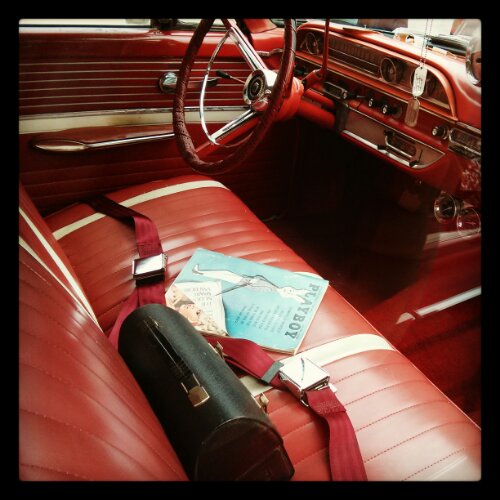

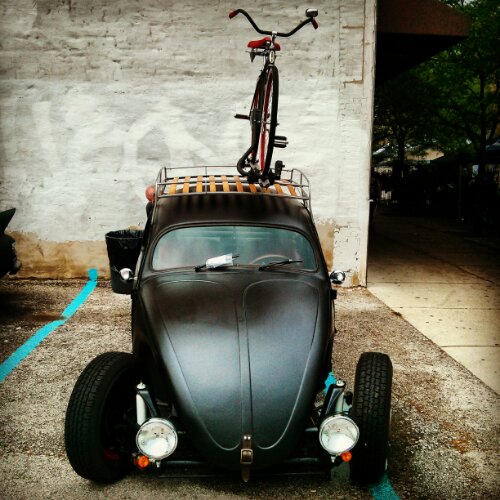


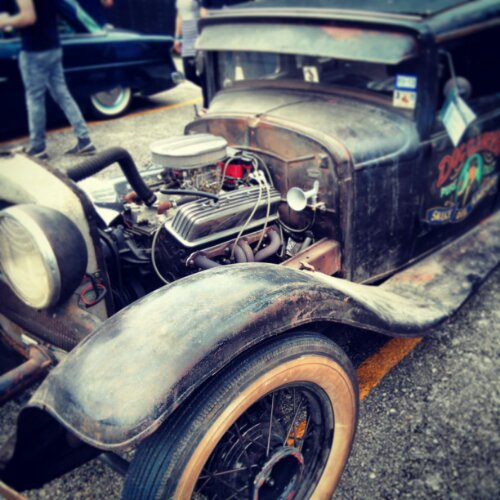
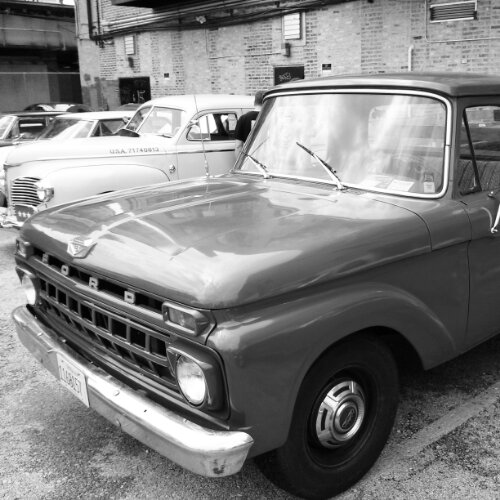
Of course the MvR meet wasn’t just about motorcycles… It also included a small car show where the four wheeled rockers drove in their 50’s vee-hick-kals. Hot rods, Rat Rods, land yachts, classic trucks, Nader’s Ford Corvair. Enjoy!
Yesterdays Mods versus Rockers bike meet was a great turnout with early rain passing and a good sun getting out. Several smart machines were seen which will be included on the blog over the next few days however this specimen stood out. It was a surgically clean, unblemished, concour quality 1968 Triumph Bonneville. It is probably cleaner than a factory fresh machine from 45 years ago.

My bike would look like an oily hack next to it. But my moto is a runner meant to get ‘hacky dorty’ on the road ahead. This is a display specimen.
Rugged knobbly tires lined up ready for a hare across the SoCal desert. Indeed it’s our old pal Steve McQueen gunning his Triumph sled for a hoof over the dust, sand and scrub if an arid Joshua tree’d scene.
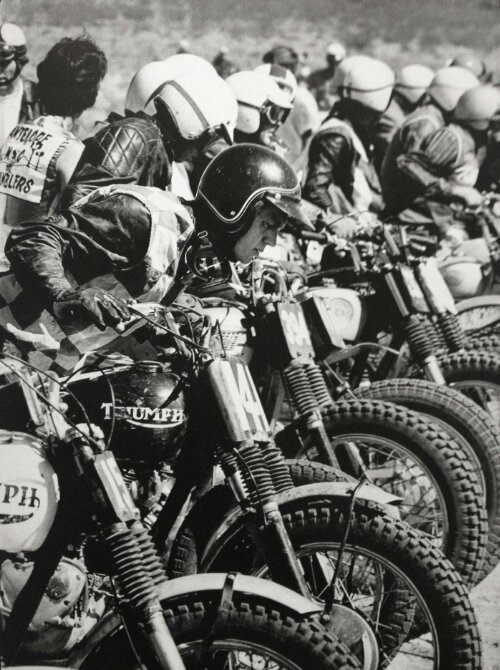
Carry water, tools, tar irons, flares, water, goggles, inner tubes, water and some more water…
The Cub was sold as a low cost transport for the post-war population who needed to get to their factory or office job, have a jaunt out with the gal across town or into the countryside, or want to tootle around on something more than a Lambaretta scooter but find the big Bonnevilles little too bike to handle.

This classic advert in grayscale with blue background has a nice active composition with a lithographical appearance. Lineweight is classic heavy edged shaped for depth which works to superb effect for this fabulously!
Crank the throttle, lift the front wheel and whoop it up! It may be a wee moto but it looks like it deals out grins by the truckload… Well 1/5 of a litre at a time!
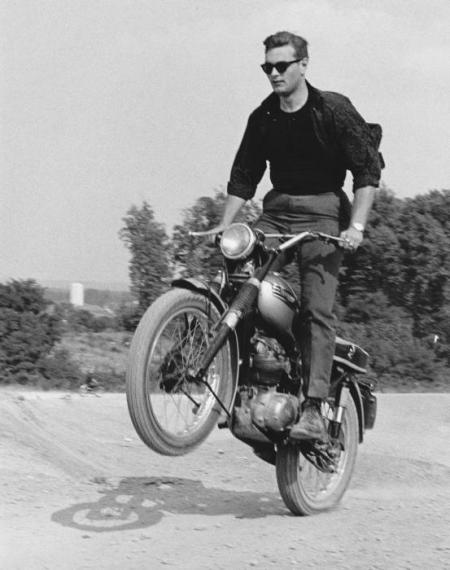
The shades are not obligatory, but help notch up the cool factor.
POW! Found one at last! The Original TV series Batman, Adam West here seen riding a Triumph Bonneville. Bat Bike…

Quite the look! However I think a dark blue/black would have been a better color to go with the flowing cape.
Nanananananananananananananananananana……BATMAN!

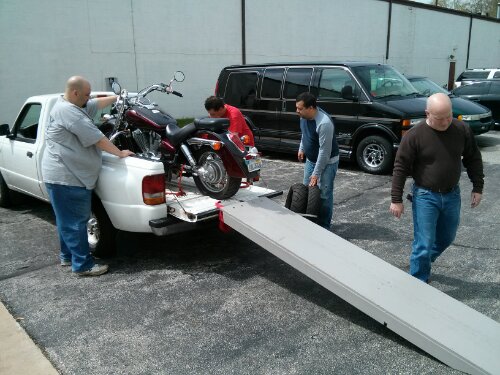
A trip to Indiana yesterday to assist a friend of Dean’s with his Honda; it was to be taken for a tire change. Dean built a nice wide ramp for its transport which made getting it into his truck a doddle.
That Honda dealer and garage was in Merriville and was a neat setup with very friendly staff. the new CB1100 was a particularly nice looking moto: classic retro lines of a seventies superbike. They had a wall of historic photographs showing past bikers and their rides, this included a past incarnation in the sixties as a Triumph dealer. The place to go to pick up your Bonneville.
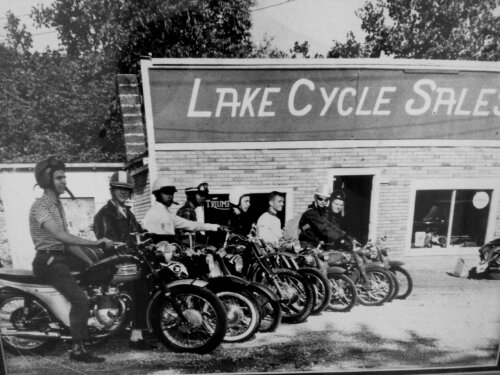
Proud owners lined up ready for a hare up to the Dunes of Michigan.
The Mountain Cub is a machine that looks at home in a rural setting. A patina of agricultural use, knobbly wheels ready for a nearby green lane into the fields and woods of countryside waiting to be explored. Fill up the true peanut-sized tank, kick ‘er over and rev the diminutive single into action and off you go! This image is a better inspiration for my rebuild than some shiny concours special needing spit ‘n’ polish and a mirror finish. I like the grubbiness of a farmhand who has just cleared out the midden and is off to milk the cows.

It’s just you, bike and nature; the sky above, the ground below…
This Tiger Cub was standing behind one of the swap stalls and even though it had a sold sign on it I had a good deek at it to see how thing attach, route, interconnect and just plain get a good feel for how a trials cub could, and should, look.
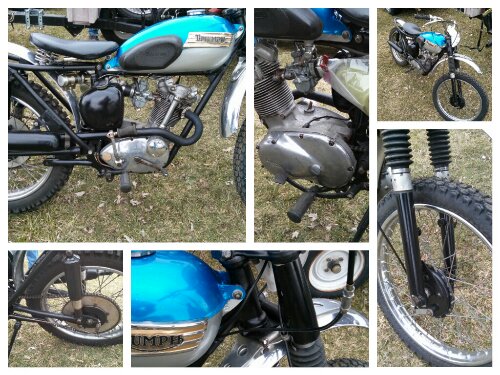
Simple, spare, sleek and single purposed.
Two by Two: the engine cases need to contain the workings of the motor. Holding the moving pats that transfer the cyclical power through clutch and gear to the back wheel and thereafter road below.
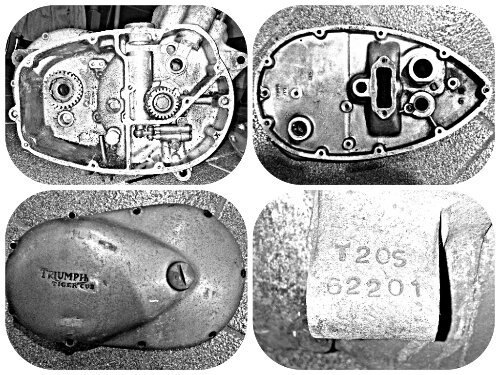
Serial number denotes a 1960 model. Frame and cases match.
How the Transmission Works.
Taken from a very clear explanation of the workings of the Cubs gearbox from Princeton site which further details student group restoration of the 200cc gem. Larn yersel motorcycle mechanics! It’s basically three shafts, two of which spin on the same center, and a series of fixed or sliding gears that interlock to achieve different drive ratios transmitting power from the engine (via the clutch) to the back wheel. Great stuff!
A detailed look into the Triumph TigerCub 4-Gear Transmission System.
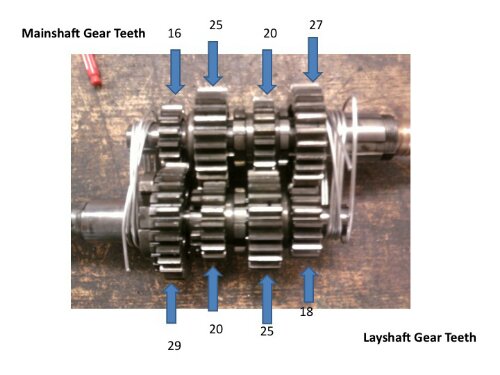
The transmission consists of two interlocking shafts with four gears each — the number of teeth on each gear is shown above.
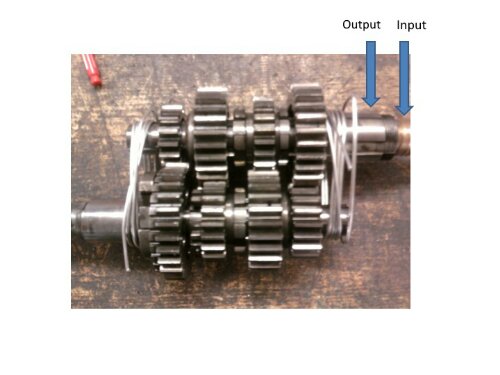
The two shafts are called the mainshaft (shown on the top) and the layshaft (on the bottom). In the TigerCub’s transmission, the mainshaft consists of two parts: the input shaft, which brings power from the engine, and the output shaft, which rides on a bearing concentric to the input shaft but outside of it, and which transmits power to the rear wheel. In the picture above, the input shaft is the smaller, copper-colored cylinder in the upper-right corner, and the output shaft is the larger, silver-colored cylinder to its immediate left.
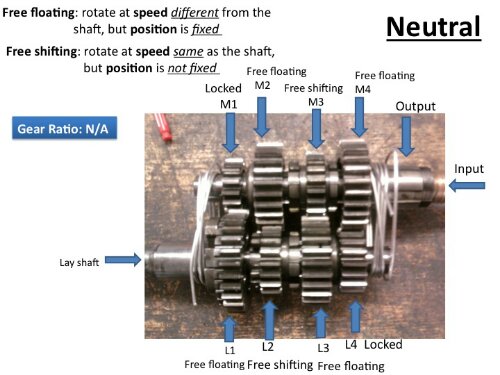
The input shaft is tied to the first and third gears on the mainshaft (M1 & M3)–that is, it co-rotates with them at the same angular velocity. M2 spins freely unless anchored to the mainshaft by M3, and M4 co-rotates with the output shaft. L2 and L4 co-rotate with the layshaft, and L1 and L3 spin freely unless anchored to the layshaft by L2.
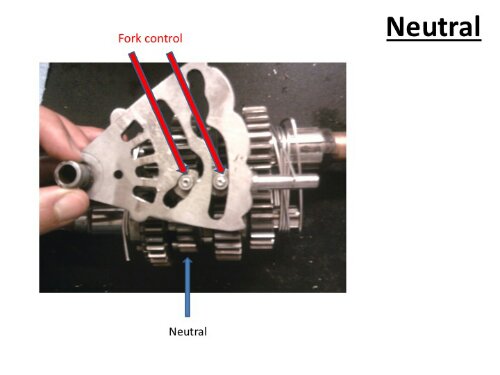
This picture shows the transmission in neutral–that is, the input is disengaged from the output, so the wheel receives no torque despite the engine’s running. M1 and M3 spin with the input shaft, but since M3 is not engaged with either M2 or M4, neither of those two rotates with the mainshaft. M1 and M3 drive L1 and L3, but since L2 is engaged with neither of those gears, they spin freely and the layshaft does not itself rotate. Thus the output via M4 is unaffected by the input.

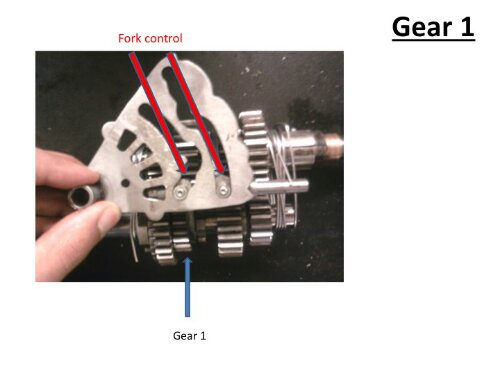
In shifting from neutral to first gear, L2 is moved to the left and engages with L1. This allows M1, co-rotating with the input, to drive the layshaft via L1. The spinning layshaft then drive M4 via L4, giving the gear ratio shown above.
Input => M1 => L1 => Layshaft => L4 => M4 => Output
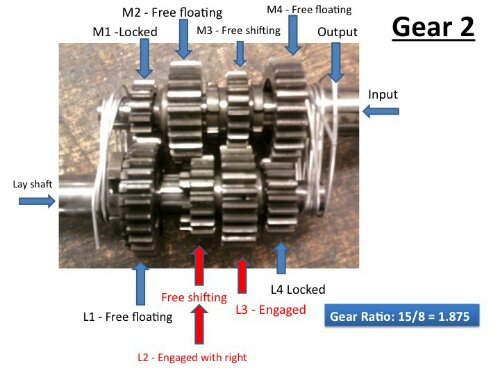
From first gear, L2 shifts to the right and engages with L3, driven by M3 in the middle position. L3 is smaller than L1, and M3 larger than M1, so a smaller gear ratio results.
Input => M3 => L3 => Layshaft => L4 => M4 => Output

In third gear, L2 shifts back to its middle position, unengaged with either L1 or L3, while M3 shifts to the left and engages with M2. M2, co-rotating with the input, drives L2.
Input => M2 => L2 => Layshaft => L4 => M4 => Output

In fourth gear, L2 remains in the middle, and M3 shifts to the right to engage directly with M4, tying the input immediately to the output. As in neutral, the layshaft is not utilized.
Input => M3 => M4 => Output
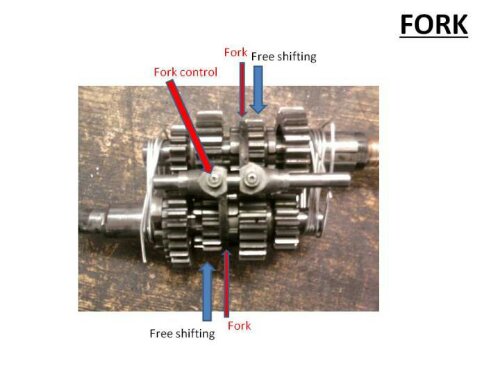
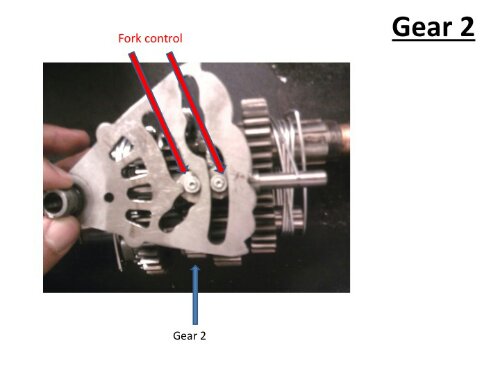
( Based on the position of the two shifting gears (M3 on the mainshaft and L2 on the layshaft), the gear ratio of the transmission is different. The forks control the position of the two shifting gears by sliding them left and right along the shaft. The forks are crescent shaped and fit into slots on the side of the shifting gears so that they are able to move the gears left and right but do not effect the rotation.

Side view of fork engaging gear shoulder.
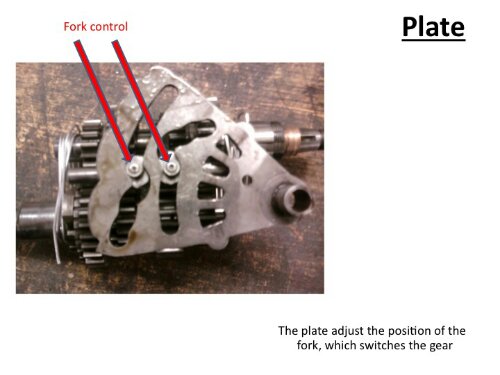
On top of each of the forks is a roller that fits into a pathway on the shifting plate. As the shifting plate changes positions, the fort-rollers follow the path, thus changing the position of the two forks. It is this motion that allows the transmission to change gears based on the position of the shifting gears.


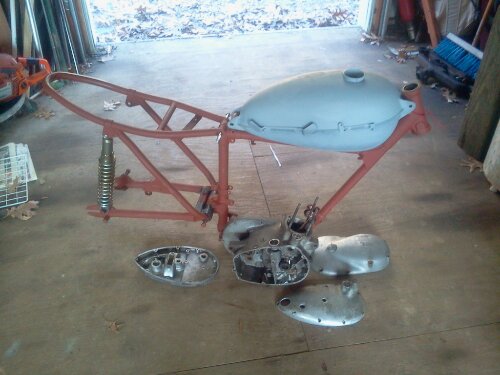
Back from a long days drive over to the NW extremity of Illinois. The charming town of Galena nestled amidst the surrounding rolling landscape of that area. Quite bucolic. The seller Bill was a retiree with bikes and cars as a hobby. He was working on a couple of Cub projects and the frame and engine cases were surplus to requirements. The above picture is posted for inspiration! Also learned of a few Cubby specialists in the vicinity which may prove useful. As Sherlock might say: “the project is afoot!”
Dear oh dear oh dear! What do I get myself into? A nice northern Illinois jaunt over to Galena tomorrow to and look at, and most likely buy, this forlorn Triumph Cub frame in need of a home. Or some motorcycle restoring sucker! Well my thoughts would be to build a wee classic trials bike. Let’s see where this green lane leads us!
How low can you go! Stretched, long-legged, chopper with a Brit-twin engine. Looks “good” in profile but bet it steers like a bus. Straight desert roads heading off into the horizon.

The pipes look like they came straight from a church organ; and the seat a prayer stool. More tea vicar? Well, at least have some with scones lashed with cream!
Stops anything in no time: or so goes the acronym for the trusty TR6 Triumphs used as speedy urban transport by the Metropolitan Police. Here are some such heavenly outriders giving Heavy police and security escort for America’s President Richard Nixon who drove from Claridges Hotel to No 10 Downing Street, London for his talks with the Prime Minister, Harold Wilson. The year is 1969.
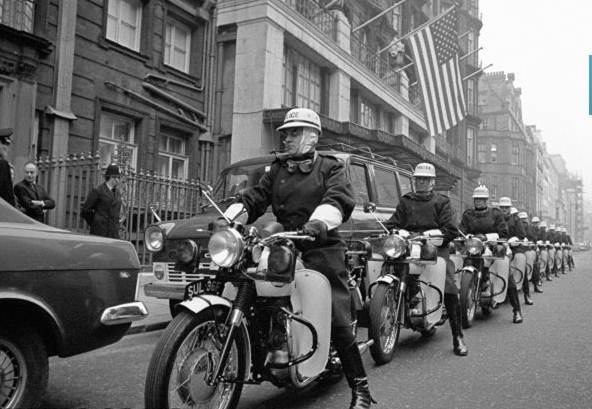
Of course this was before the downward spiral of the Meriden shenanigans over the next decade; the police would then take to rotary Nortons and big faired Beemers. However these ‘post-war’ Triumphs gave a very traditional quality to the bobby-on-the-bike!
Here’s another couple of photos from these times showing a perfect line up of Speed Twins and Thunderbirds that the boys in blue loved to speed up and down the country on – when freshly laid motorways were quiet and getaway cars were slow…


Of course the moto’s were used around the world in far flung commonwealth colonies law enforcement units too.
Ah, imagine being the local officer toting around Kingston Jamaica in khaki shorts atop a sweet 500 Triumph; pop over to coral cove for a spot of fishing later on!
 geordiebiker.com