Archive for ‘Triumph Motorcycle’

April 16, 2013

Thruxton Racer

We stopped into Woodstock Triumph on Sunday, and after meandering through the Harley googling throngs clad in their ‘biker’ leathers and eyes bedazzled by chrome by the acre and bike by the hundredweight, I happened upon this cracker if a moto. A race ready Triumph twin with lashings of speed worthy components. But it doesn’t look over the top; just a sublime machine for gannin’ quick, gannin’ roond, and honkin’ on the anchors when needed.

image

As the fork says the rider is one Brice Cooper. http://www.bricecooper.com
Here it is in action. As Graham Hill would probably say “Useful Tool, has a bit of poke”

image

April 13, 2013

‘Gin

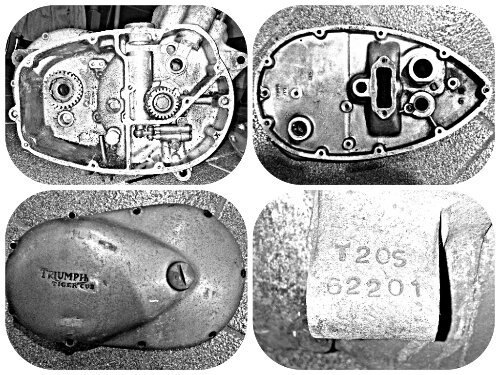
Two by Two: the engine cases need to contain the workings of the motor. Holding the moving pats that transfer the cyclical power through clutch and gear to the back wheel and thereafter road below.

image

Serial number denotes a 1960 model. Frame and cases match.

April 10, 2013

All Geared Up

How the Transmission Works.

Taken from a very clear explanation of the workings of the Cubs gearbox from  Princeton site which further details student group restoration of the 200cc gem. Larn yersel motorcycle mechanics! It’s basically three shafts, two of which spin on the same center, and a series of fixed or sliding gears that interlock to achieve different drive ratios transmitting power from the engine (via the clutch) to the back wheel. Great stuff!

A detailed look into the Triumph TigerCub 4-Gear Transmission System.
image

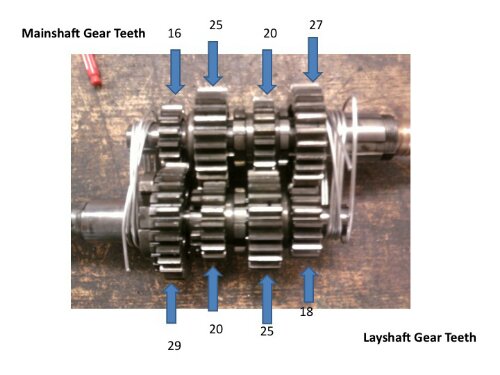
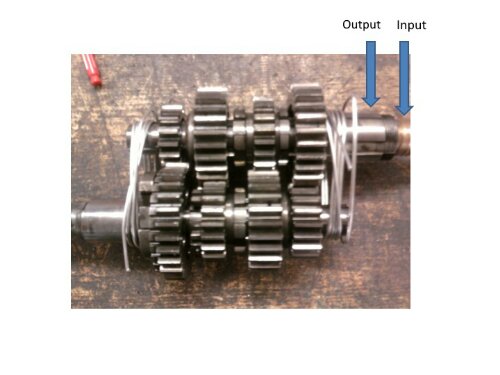
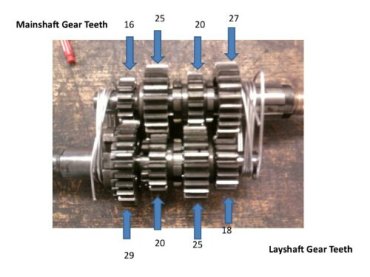
The transmission consists of two interlocking shafts with four gears each — the number of teeth on each gear is shown above.

image

The two shafts are called the mainshaft (shown on the top) and the layshaft (on the bottom). In the TigerCub’s transmission, the mainshaft consists of two parts: the input shaft, which brings power from the engine, and the output shaft, which rides on a bearing concentric to the input shaft but outside of it, and which transmits power to the rear wheel. In the picture above, the input shaft is the smaller, copper-colored cylinder in the upper-right corner, and the output shaft is the larger, silver-colored cylinder to its immediate left.

image

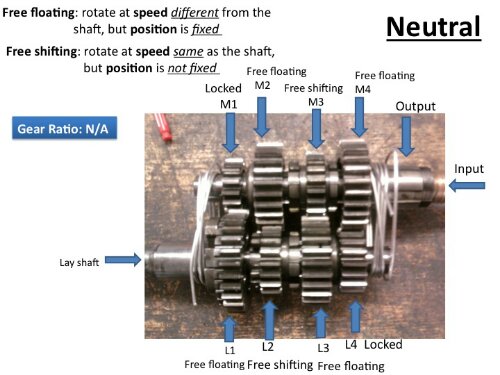
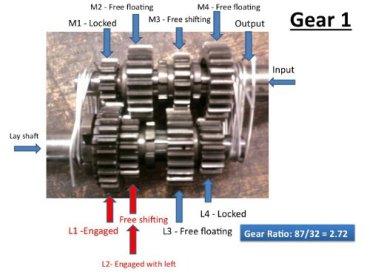
The input shaft is tied to the first and third gears on the mainshaft (M1 & M3)–that is, it co-rotates with them at the same angular velocity. M2 spins freely unless anchored to the mainshaft by M3, and M4 co-rotates with the output shaft. L2 and L4 co-rotate with the layshaft, and L1 and L3 spin freely unless anchored to the layshaft by L2.

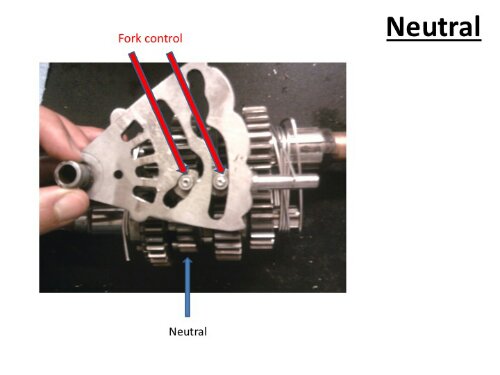
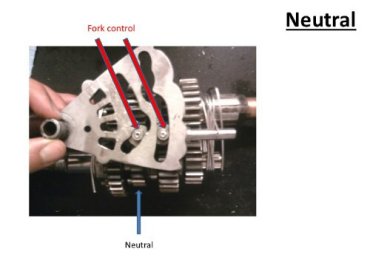
This picture shows the transmission in neutral–that is, the input is disengaged from the output, so the wheel receives no torque despite the engine’s running. M1 and M3 spin with the input shaft, but since M3 is not engaged with either M2 or M4, neither of those two rotates with the mainshaft. M1 and M3 drive L1 and L3, but since L2 is engaged with neither of those gears, they spin freely and the layshaft does not itself rotate. Thus the output via M4 is unaffected by the input.
image

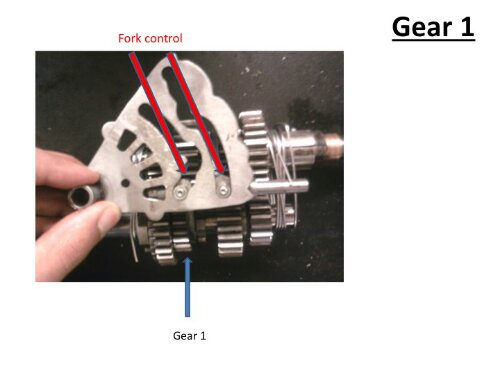
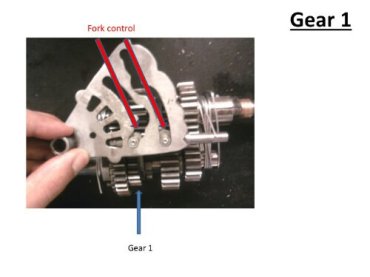
In shifting from neutral to first gear, L2 is moved to the left and engages with L1. This allows M1, co-rotating with the input, to drive the layshaft via L1. The spinning layshaft then drive M4 via L4, giving the gear ratio shown above.

Input => M1 => L1 => Layshaft => L4 => M4 => Output

image

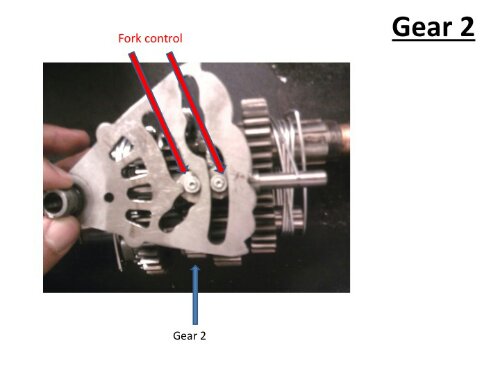
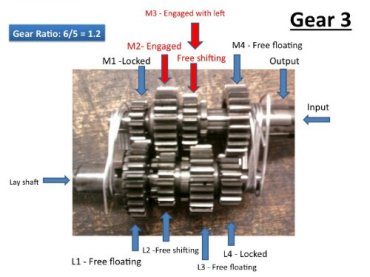
From first gear, L2 shifts to the right and engages with L3, driven by M3 in the middle position. L3 is smaller than L1, and M3 larger than M1, so a smaller gear ratio results.

Input => M3 => L3 => Layshaft => L4 => M4 => Output
image

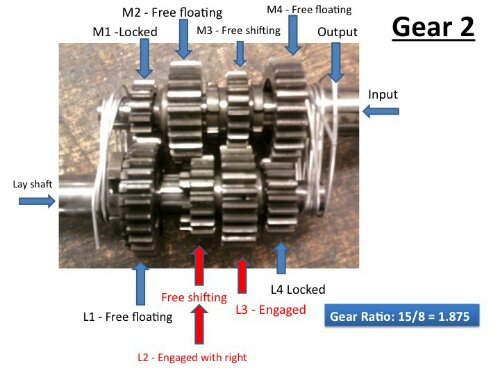
In third gear, L2 shifts back to its middle position, unengaged with either L1 or L3, while M3 shifts to the left and engages with M2. M2, co-rotating with the input, drives L2.

Input => M2 => L2 => Layshaft => L4 => M4 => Output
image

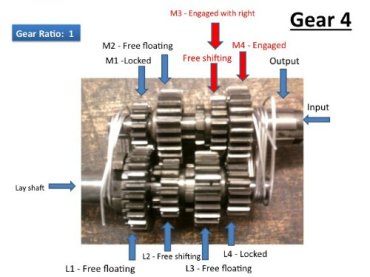
In fourth gear, L2 remains in the middle, and M3 shifts to the right to engage directly with M4, tying the input immediately to the output. As in neutral, the layshaft is not utilized.

Input => M3 => M4 => Output

image

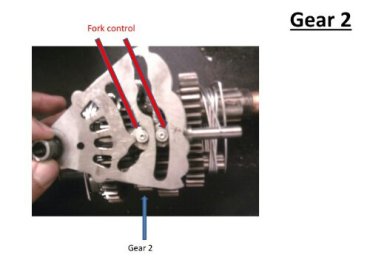
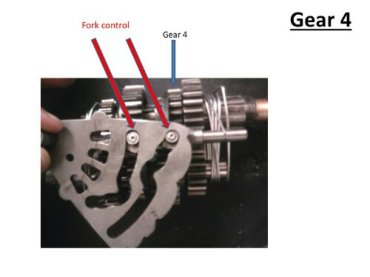
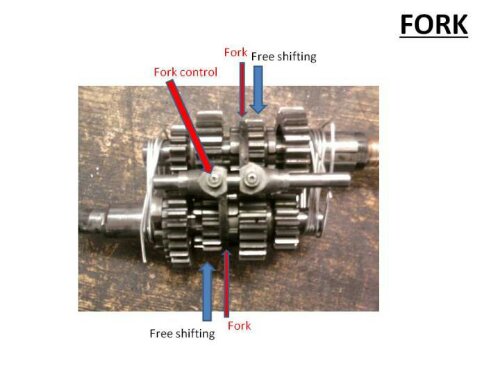
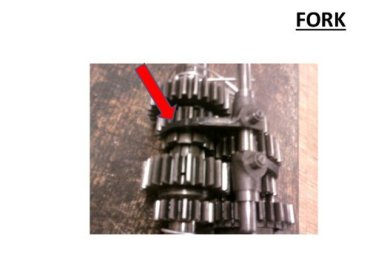
( Based on the position of the two shifting gears (M3 on the mainshaft and L2 on the layshaft), the gear ratio of the transmission is different.  The forks control the position of the two shifting gears by sliding them left and right along the shaft.  The forks are crescent shaped and fit into slots on the side of the shifting gears so that they are able to move the gears left and right but do not effect the rotation.
image

Side view of fork engaging gear shoulder.
image

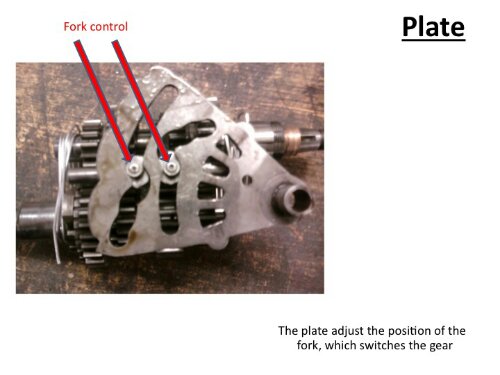
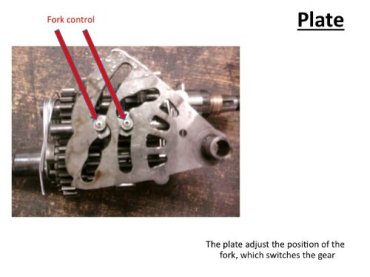
On top of each of the forks is a roller that fits into a pathway on the shifting plate. As the shifting plate changes positions, the fort-rollers follow the path, thus changing the position of the two forks. It is this motion that allows the transmission to change gears based on the position of the shifting gears.
image

image

image

image

image

April 8, 2013

The Watchmaker

image

The wee Tiger Cub engine sure is cute: indeed after getting around the burly 650 Bonnie lump this is a thing of delicate precision. A pocket watch rather than a grandfather clock. I’m looking forward to exploring the guts of its inner workings: the single piston and supporting parts; an incorporated gearbox with four geared meshing and the tac-tic of the rocker arms as they open and close both inlet and exhaust valves. Var nigh simple engineering perfection.

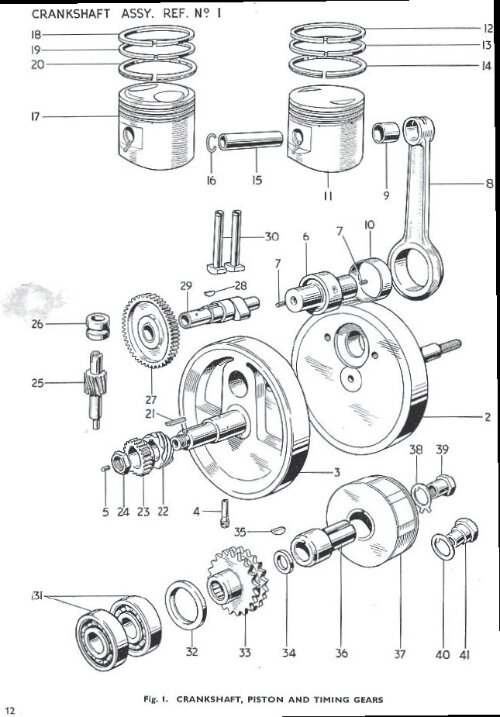
Of course the finely drafted exploded views from the essential parts manual help one find a way around the mechanics. Like a Greys Anatomy for the bike in question.

image

I hope I can scrounge up the parts to get this little ticker working again!

April 7, 2013

Cub Advert

As part of the work involved in a restoration you get to enjoy delving into the history of the bike; part of which is examining original advertising illustrations. Here’s a smashing item from some brochure extolling the virtues of these fifth liter machines. A Tiger Cub and Sport Cub: both T20.

image

Of course having the words of a real world champion quoted on the ad doesn’t do any harm either. Here Belgian Roger Vanderbrecken give a positive review of the Cubs.

April 6, 2013

Cub is a baby bear

image

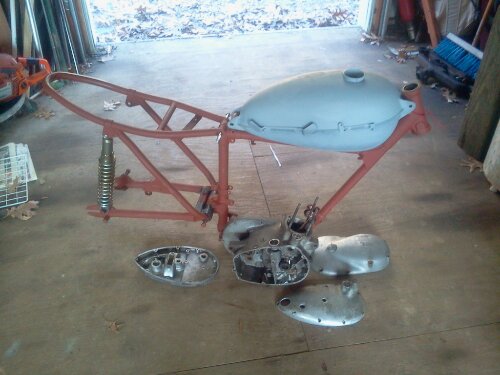
Back from a long days drive over to the NW extremity of Illinois. The charming town of Galena nestled amidst the surrounding rolling landscape of that area. Quite bucolic. The seller Bill was a retiree with bikes and cars as a hobby. He was working on a couple of Cub projects and the frame and engine cases were surplus to requirements. The above picture is posted for inspiration! Also learned of a few Cubby specialists in the vicinity which may prove useful. As Sherlock might say: “the project is afoot!”

April 5, 2013

Next Project…

Dear oh dear oh dear! What do I get myself into? A nice northern Illinois jaunt over to Galena tomorrow to and look at, and most likely buy, this forlorn Triumph Cub frame in need of a home. Or some motorcycle restoring sucker! Well my thoughts would be to build a wee classic trials bike. Let’s see where this green lane leads us!
image

March 29, 2013

Ah le lapin: un cadeau!

When you need to be chased by a greyhound then dress in a white rabbit outfit hop on a sweet Triumph Bonnie and then go like a hare! Well it is easter and I’m sure the magicians top hat prop seemed like a good idea at the time.

image

Go ask Alice!

March 26, 2013

Walking Away?

Don’t turn your back on the bike! Here’s a lady rider with a bobb’d chopp’d, ape’d & defender’d Triumph moto.

image

Nicely composed image, subject and portrait of a bike and its owner.

March 25, 2013

Always stretch before or after rigorous exercise!

How low can you go! Stretched, long-legged, chopper with a Brit-twin engine. Looks “good” in profile but bet it steers like a bus. Straight desert roads heading off into the horizon.

image

The pipes look like they came straight from a church organ; and the seat a prayer stool. More tea vicar? Well, at least have some with scones lashed with cream!

March 24, 2013

In Detail

image

From the Triumph website:

Thruxton.    The café racer.    Reinvented.

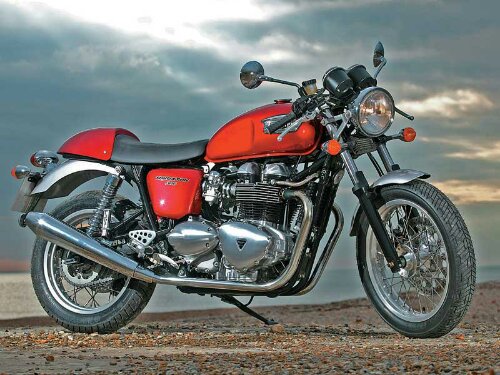
Thruxton. Named after the race track where Triumph ruled the roost and inspired by the famous “Ton Up Boys” of the 60s. The Thruxton is Triumph’s sportiest classic, an authentic café racer delivering that unique Brit twin riding experience. Low rise bars, sporty riding position, aluminum-rimmed spoked wheels (18” front and 17” rear), megaphone style exhaust and a modern 865cc parallel-twin engine. It stirs the heart for those around at the time and for those who seek the classic sporty retro cool.

ENGINE: FUEL & IGNITION SYSTEM:
• Air-cooled, DOHC, 360º parallel twin
• Twin carburettors
• Capacity 865cc
• TPS and electric heaters
• Compression Ratio 10.2:1
• Ignition Digital – inductive type
• Bore/Stroke 90 x 68mm

TRANSMISSION: PERFORMANCE:
• Primary – Drive Gear
• Maximum Power 70PS (69bhp) at 7,250rpm
• Final Drive – X ring chain
• Maximum Torque 72Nm (53ft.lbf) at 5,750rpm
• Gearbox 5-speed
• measured at crankshaft to DIN 70020
• Clutch – Wet, multi-plate

DIMENSIONS: CYCLE PARTS:
• Length 2212mm (87.1in)
• Swingarm Twin-sided, tubular steel
• Width (Handlebars) 714mm (28.1in)
• Wheels
   – Front, 36-spoke, 18 x 2.5in,
   – Rear, 40-spoke, 17 x 3.5in
• Seat Height 790mm (31.1in)
• Tyres – Front R18 100/90, Rear R17 130/80
• Height 1170mm (46.1in)
• Suspension
   – 41mm forks with adjustable preload,
   – Rear – twin shocks, adjustable pre-load
• Weight (Dry) 205kg (451lb)
• Brakes
   – Front, Single 320mm floating disc, 2 piston caliper, Rake/27º Trail/97mm                
   – Rear,  Single 255mm disc, 2 piston caliper
• Fuel Tank Capacity 16 litres (4.2 gal US)
• Wheelbase 1477mm (58.1in)

March 18, 2013

A Thousand Words and more…

Stumbled upon this fab painting of a gal riding a Bonnie along a sunny coastal road. Great color, simple daub-work, and perfect subject. Need to get out my oils and canvas and get back to some paintin’.

image

March 15, 2013

Art App Fun

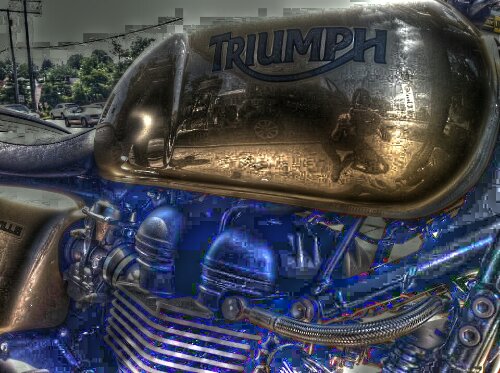
My new Google phone has some neat photo editing apps available; here’s a few examples:

image

image

image

image

March 14, 2013

A Fork in the Road

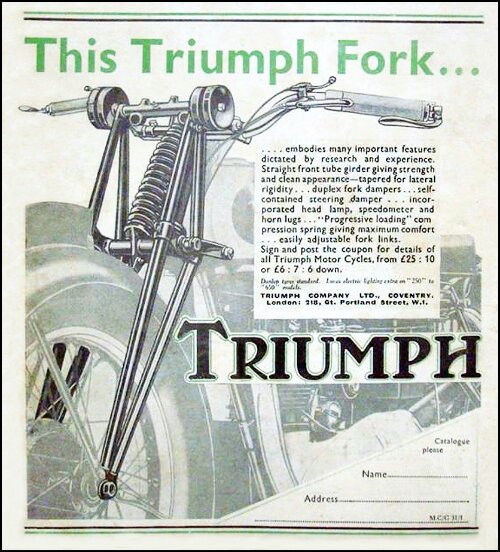
When men were men and roads were barely tarmacadam’d from the cobbled and dirt roads of yestercentury; there was a need to give some shock absorption to the steering proceedings. Otherwise anything above a running pace and the ‘bars would be whipped out of your gauntletted hands. Not Good. Unless you enjoy testing your Tweeds and cloth cap! Here’s the Coventry Company’s early efforts of a girder fork. Simple action, serviceable and met the needs of the expanding moto-denizens. Indeed Phil Vincent used this system on the classically sublime Vincent over its lifetime of much sought after models.

image

March 10, 2013

G’day mate!

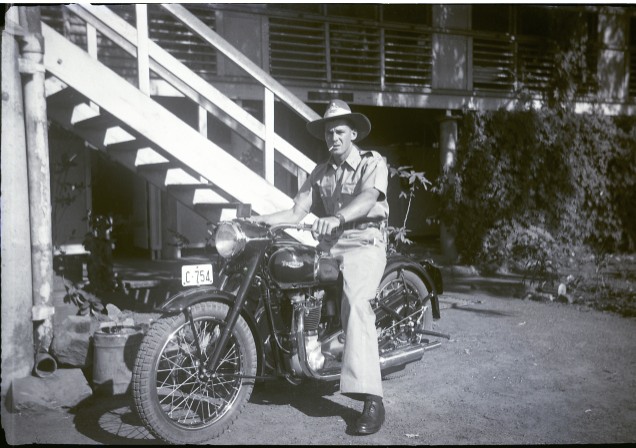
Another law enforcing rider; this time an antipodean one… Here’s a slouch hatted cobber ready for pulling over some tinnie slurpin’ Bruce driving home in his ute from a barbie.

image