Archive for ‘Restoration’

April 14, 2013

01 811. 8055

“Noel I’d like to swap my dart board for a football”. I spent the day up at the swap meet held in the McHenry county fairground in Woodstock. Indeed the organizers Walneck held a 100th meet celebration at the nearby Harley, Triumph KTM dealer, so it was bikes all round old and new; rusty and polished.

image

There was engines galore cat Ed Zenders post, alas no Cub items. But I managed to pick up the much needed Haynes manual an a set of Whitworth spanners.

image

I’ve never seen a copper tank either- steam punk anyone?

image

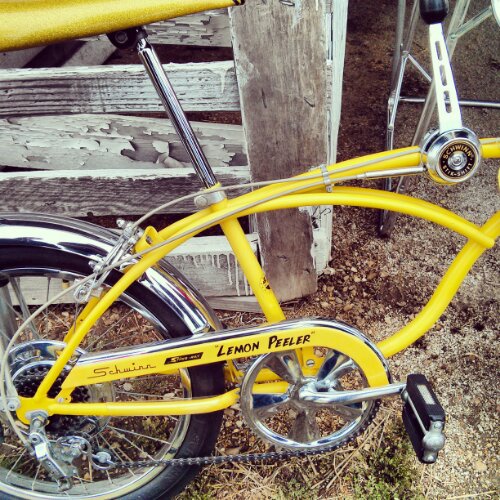
There was other two-wheeled offerings too: this immaculate “Christmas Morning” fresh Schwinn Stingray chopper, the Lemon Peeler was propped against a pig stall, yours for $1,400. “What do you mean? Won’t ‘aggle?”

image

I’ll report other discoveries over the coming weeks blog entries. Plenty of moto fun!

April 13, 2013

‘Gin

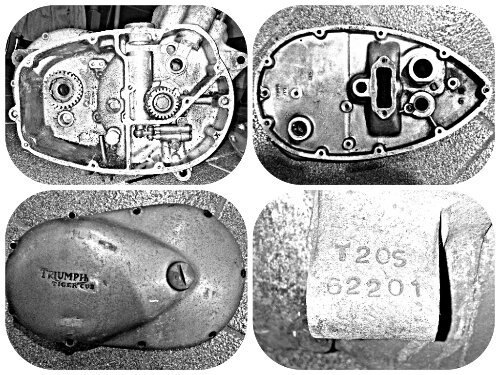
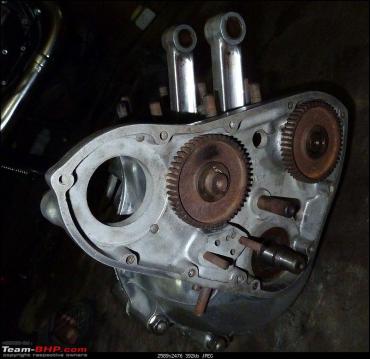
Two by Two: the engine cases need to contain the workings of the motor. Holding the moving pats that transfer the cyclical power through clutch and gear to the back wheel and thereafter road below.

image

Serial number denotes a 1960 model. Frame and cases match.

April 10, 2013

All Geared Up

How the Transmission Works.

Taken from a very clear explanation of the workings of the Cubs gearbox from  Princeton site which further details student group restoration of the 200cc gem. Larn yersel motorcycle mechanics! It’s basically three shafts, two of which spin on the same center, and a series of fixed or sliding gears that interlock to achieve different drive ratios transmitting power from the engine (via the clutch) to the back wheel. Great stuff!

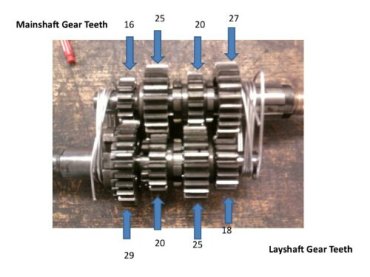
A detailed look into the Triumph TigerCub 4-Gear Transmission System.
image

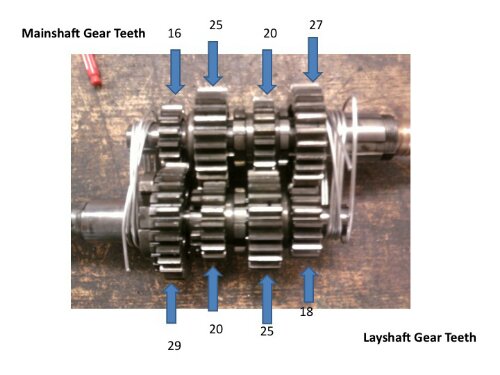
The transmission consists of two interlocking shafts with four gears each — the number of teeth on each gear is shown above.

image

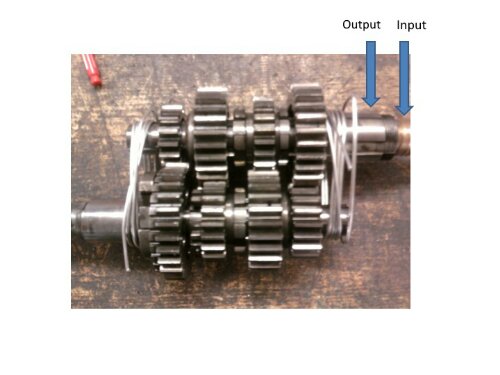
The two shafts are called the mainshaft (shown on the top) and the layshaft (on the bottom). In the TigerCub’s transmission, the mainshaft consists of two parts: the input shaft, which brings power from the engine, and the output shaft, which rides on a bearing concentric to the input shaft but outside of it, and which transmits power to the rear wheel. In the picture above, the input shaft is the smaller, copper-colored cylinder in the upper-right corner, and the output shaft is the larger, silver-colored cylinder to its immediate left.

image

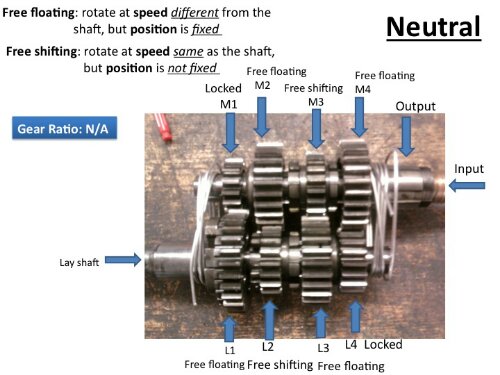
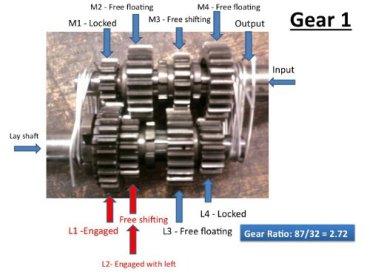
The input shaft is tied to the first and third gears on the mainshaft (M1 & M3)–that is, it co-rotates with them at the same angular velocity. M2 spins freely unless anchored to the mainshaft by M3, and M4 co-rotates with the output shaft. L2 and L4 co-rotate with the layshaft, and L1 and L3 spin freely unless anchored to the layshaft by L2.

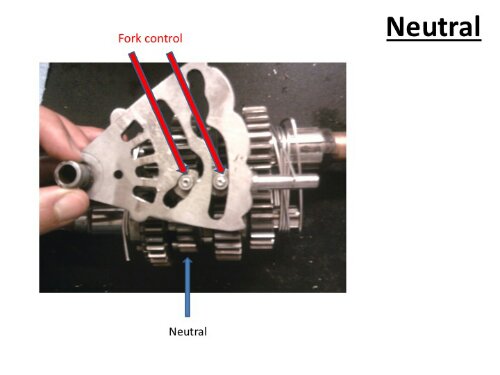
This picture shows the transmission in neutral–that is, the input is disengaged from the output, so the wheel receives no torque despite the engine’s running. M1 and M3 spin with the input shaft, but since M3 is not engaged with either M2 or M4, neither of those two rotates with the mainshaft. M1 and M3 drive L1 and L3, but since L2 is engaged with neither of those gears, they spin freely and the layshaft does not itself rotate. Thus the output via M4 is unaffected by the input.
image

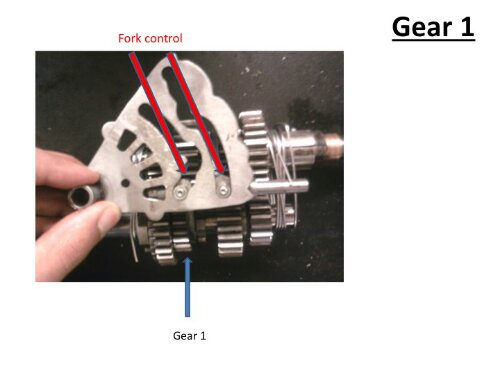
In shifting from neutral to first gear, L2 is moved to the left and engages with L1. This allows M1, co-rotating with the input, to drive the layshaft via L1. The spinning layshaft then drive M4 via L4, giving the gear ratio shown above.

Input => M1 => L1 => Layshaft => L4 => M4 => Output

image

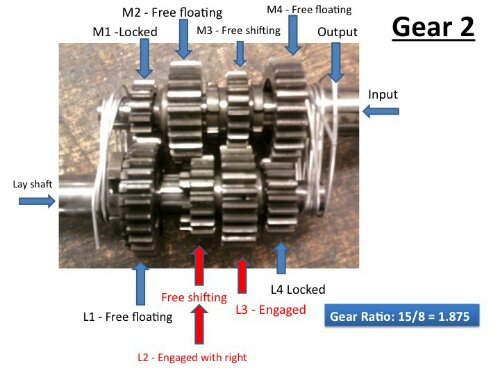
From first gear, L2 shifts to the right and engages with L3, driven by M3 in the middle position. L3 is smaller than L1, and M3 larger than M1, so a smaller gear ratio results.

Input => M3 => L3 => Layshaft => L4 => M4 => Output
image

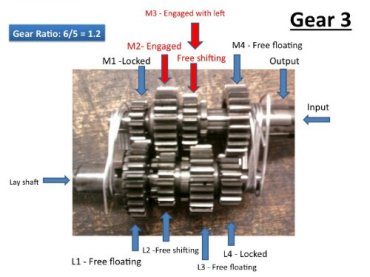
In third gear, L2 shifts back to its middle position, unengaged with either L1 or L3, while M3 shifts to the left and engages with M2. M2, co-rotating with the input, drives L2.

Input => M2 => L2 => Layshaft => L4 => M4 => Output
image

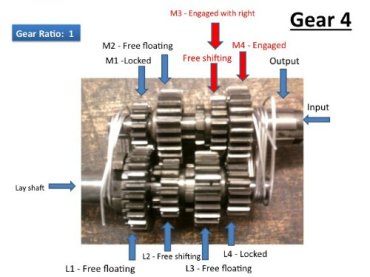
In fourth gear, L2 remains in the middle, and M3 shifts to the right to engage directly with M4, tying the input immediately to the output. As in neutral, the layshaft is not utilized.

Input => M3 => M4 => Output

image

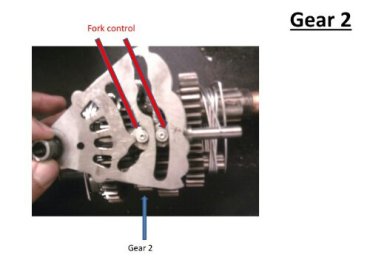
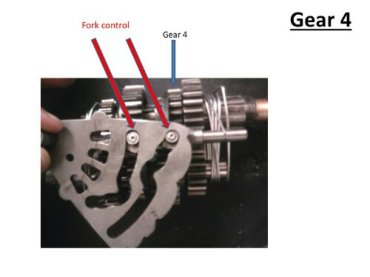
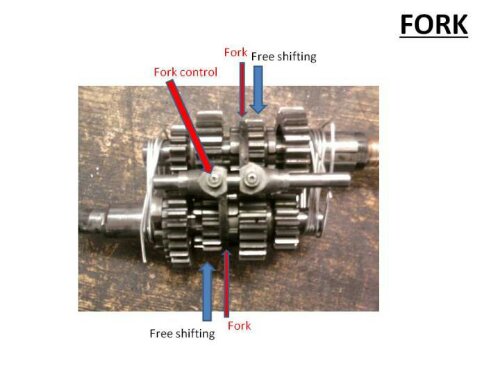
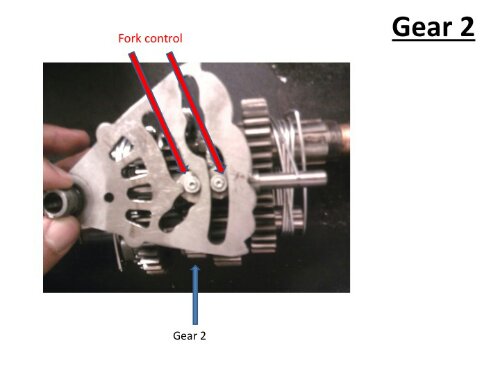
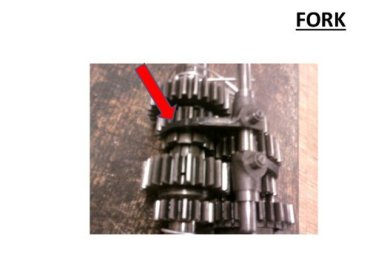
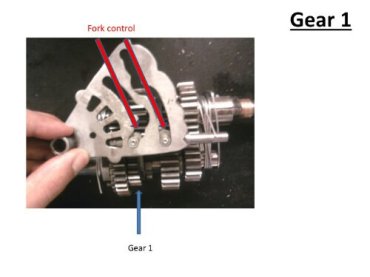
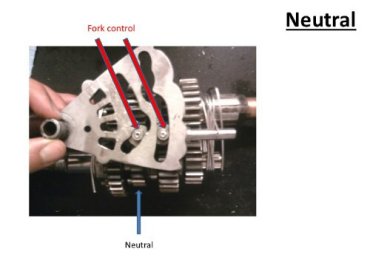
( Based on the position of the two shifting gears (M3 on the mainshaft and L2 on the layshaft), the gear ratio of the transmission is different.  The forks control the position of the two shifting gears by sliding them left and right along the shaft.  The forks are crescent shaped and fit into slots on the side of the shifting gears so that they are able to move the gears left and right but do not effect the rotation.
image

Side view of fork engaging gear shoulder.
image

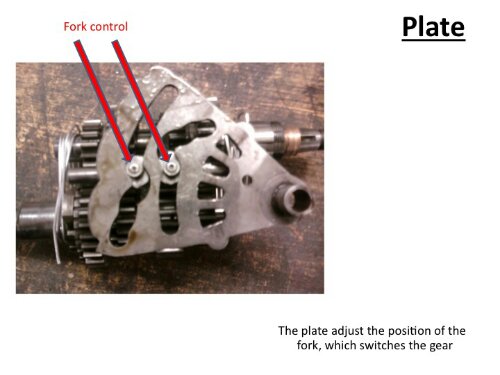
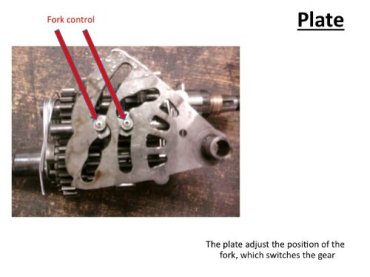
On top of each of the forks is a roller that fits into a pathway on the shifting plate. As the shifting plate changes positions, the fort-rollers follow the path, thus changing the position of the two forks. It is this motion that allows the transmission to change gears based on the position of the shifting gears.
image

image

image

image

image

April 9, 2013

One mans workshop

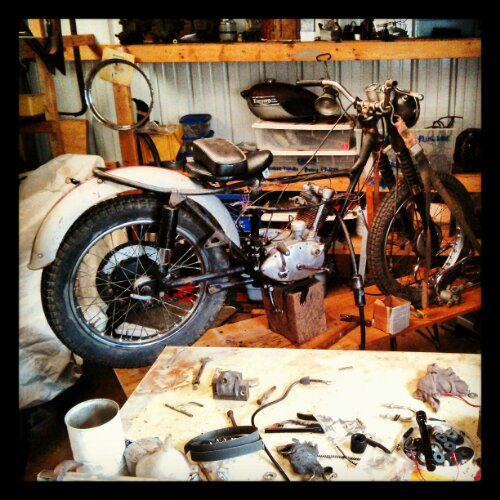
At the weekend when picking up the cub I had a spoach around the sellers workshop. He had a nicely organized garage set up with areas for working on different projects: another Tiger Cub, a Bultaco. There was even a flat track 650 hiding under a tarp. Shelves were lined with boxed and sorted spares, the rafters were draped in exhaust pipes and a daylit window offered good light.

image

Back in town another ‘collectors’ trove was introduced to us. This time the hoarding was more in evidence. Numerous British bikes, mostly BSA’s but a couple of Ariel’s in the corner, were lined up in grand sequence: a 40’s military M20, an A10, A65, B40. On his worktop stood a mostly complete 350 Beeza; free’d cylinders, new fluids, and it’ll be a runner in original patina. Smashing!

image

April 8, 2013

The Watchmaker

image

The wee Tiger Cub engine sure is cute: indeed after getting around the burly 650 Bonnie lump this is a thing of delicate precision. A pocket watch rather than a grandfather clock. I’m looking forward to exploring the guts of its inner workings: the single piston and supporting parts; an incorporated gearbox with four geared meshing and the tac-tic of the rocker arms as they open and close both inlet and exhaust valves. Var nigh simple engineering perfection.

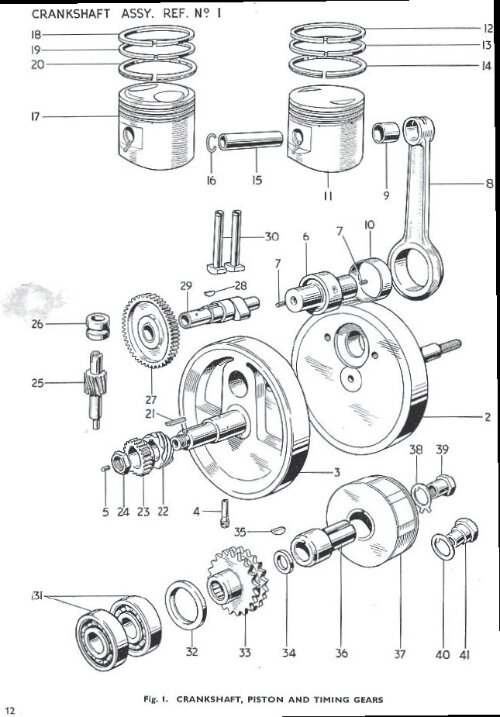
Of course the finely drafted exploded views from the essential parts manual help one find a way around the mechanics. Like a Greys Anatomy for the bike in question.

image

I hope I can scrounge up the parts to get this little ticker working again!

April 6, 2013

Cub is a baby bear

image

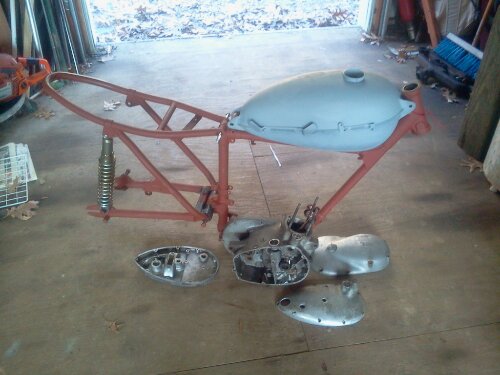
Back from a long days drive over to the NW extremity of Illinois. The charming town of Galena nestled amidst the surrounding rolling landscape of that area. Quite bucolic. The seller Bill was a retiree with bikes and cars as a hobby. He was working on a couple of Cub projects and the frame and engine cases were surplus to requirements. The above picture is posted for inspiration! Also learned of a few Cubby specialists in the vicinity which may prove useful. As Sherlock might say: “the project is afoot!”

April 5, 2013

Next Project…

Dear oh dear oh dear! What do I get myself into? A nice northern Illinois jaunt over to Galena tomorrow to and look at, and most likely buy, this forlorn Triumph Cub frame in need of a home. Or some motorcycle restoring sucker! Well my thoughts would be to build a wee classic trials bike. Let’s see where this green lane leads us!
image

November 9, 2012

“It’s Alive!”

There are few more satisfying things than sitting astride your rebuilt moto, kicking the engine to life and roaring down the road. Our chum Sanjay is seen here with his Speed Twin on a jaunt along the coast road near Chennai, India. Worldwide people like to see and hear the distinctive lines and grump of an old motorcycle. It is kind of a reminder of days when things were somewhat simpler and people managed with the world at that speed; these days we’re all too rushed with the blitzing pace of a world connected. Getting aboard these old gals and haring along a quiet winding country lane calms the spirit and breathes a fresh lease into your life. Batteries charged? Yup!

November 8, 2012

Light the Blue touch paper……..~*

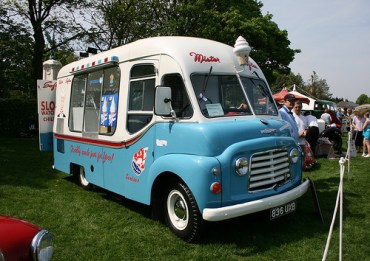
It all comes together: wheels are laced and new tyres shod onto the spruced up rims. Let’s not talk about the blueness… it’s somewhat bright, like an ice cream van from my youth… … but I’m sure in the right company and setting it looks perfect.


Nevertheless, bolting the chassis together with the ‘new’ tins, triple-tree’d forks and various brakeing, oiling, wiring appendages and fixin’s.

The headlight nacelle is a gorgeous unified design element of these twins, it’s a shame they didn’t keep this going through to later models, or even bring this back to the modern classics… … the Smiths Clocks look potent too – put’s the speed in Speed Twin.

Shoehorn the engine in, pop on the wheels and a motorcycles rebirth is imminent. Love the wall mounted tool rack, specialist pullers, keys, and Whitworth spangles are touched by the patina of oily hands.

The penultimate throes of the project always throw up hidden gremlins: tolerances between refinished and new parts, Lucasian electrical imps, and the other item that always takes patience: the paperwork. Every country, state, municipality, hamlet, whatever needs the bike registered, licensed , titled, taxed etc. A wad of document nearly as thick as the receipts for parts, machine work, painting, and the miscellaneous nut, bolts and washers renewed sith stainless steel replacements to allay future rot from damp Bengal Bay breezes…

oh, and the ice cream van? Mr Softee, Wall’s, ours was Coxon’s Ices of Seahouses.


November 7, 2012

“Once more the Engine of her Thoughts began…”

Organisation is the Key to Success! Accumulating parts needs diligence especially when there is a lot of aftermarket bike parts not quite up to spec… i bought a clutch cable that lasted a hundred miles… you need to pay appropriately for some critical components. Can you clean up an original oily part off Ebay? Or cough up the dough for a new component from one of the small fabricators still making items for these old moto-madams? Don’t scamp on Far East parts though… it ain’t worth it!

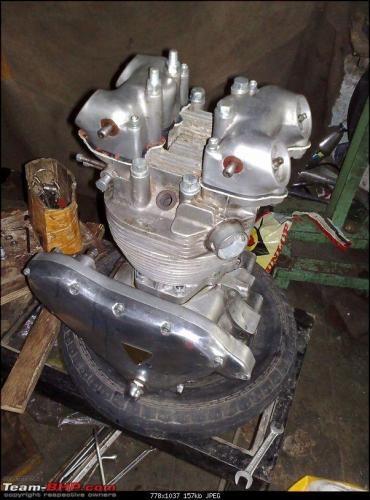
Clean components, smooth swingin’ con-rods, sharp toothed gears, flat faced joints, new seals and assembly continues. I left my engine to an Brit Iron specialist, Ed Zender at Morries Place, with decades of experience, to get my ‘gin back into shape.

Once reassembled these twins are truly a work of art. Used in worldwide selling models by the Coventry company for nigh on half a century. You could display it in a gallery; though I’d rather see it ensconced in a rolling chassis, oil fed and petrol fired to romp you down the road…

(Heading is Bill Shakespeare)


November 6, 2012

Scientia potentia est

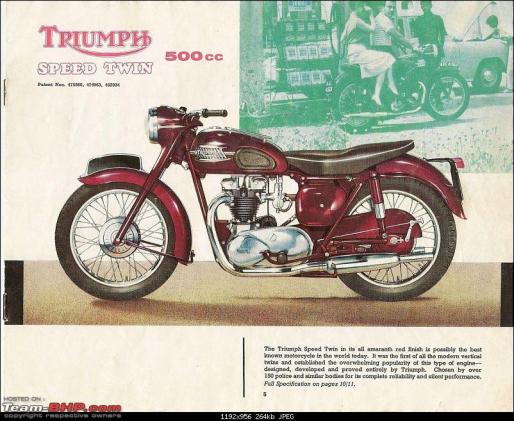
Knowledge is Power! When embarking on the restoration odyssey gleaning as much information as possible  about your particular moto is one of the most pleasurable. Well before bloodied knuckles, cursing screams and emptying coffers turn ‘The Project’ into a seemingly unendurable rout, amassing the history, details, period test articles, manuals is a great way to start learning about your machine.

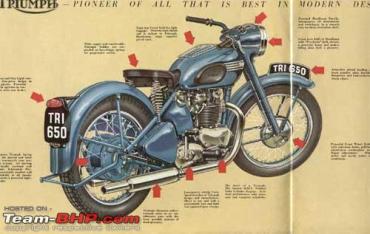
Advertising is a good start: how did the team in the boardroom want to sell the ‘bikes? Fun, functionality? Or just those sleek, sweet lines of a steed of speed?

Remember this was modern design of it’s day! Features that put it above and beyond of the competition (bar a Vincent Black Lightning of course…). Love those illustrations, which were for the most part direct traced renderings of photographs.

“And Lo, it came to pass…”

Better get yerself a decent shelf-full of manuals which illustrate in line and photo how to both dismantle the machine and then put ‘er back together without leaving so much as a nut or bolt out. The Haynes book is legend as a well organised tome which presents a blow-by-blow account of the major sections of a motorcycle: engine, gearbox, chassis, suspension, wheels, and electrics.

A ‘Bible’ it seems, but more of a concise survey of the model; well worth a peruse to understand a bikes development. When did the rigid frame give up for a swing arm? What years have the smart nacelle headlight shroud? What colour was applied in what year?

Of course noting is a substitute for an Owners Instruction Manual, Workshop Manual and Replacement Parts Book. These are essential for the devoted restoree…  … we hope you haven’t given up yet! Has the parts been delegated to a corner of the garage yet? Don’t lose heart, the fun hasn’t even started yet!

One of the most important things you DO need at this point in the game is an inspiration, a vision of your goal.  Good photos of your model abound on the ‘Web for this. But one better thing would be to look at a bike ‘in the flesh’; look it over, take your own photos; if you could even ride it (if the devoted owner lets you) that’ll give you a faster pulse and the energy to forge ahead…

November 5, 2012

An Oily Autopsy

Unzipping an old moto, engine and chassis both, gives the restorer the first view of the road ahead. Will parts be useable with necessary cleaning and restoring or will a new replacement be needed? Our Speed Twin shows a veritable horror story when the internals are laid bare…

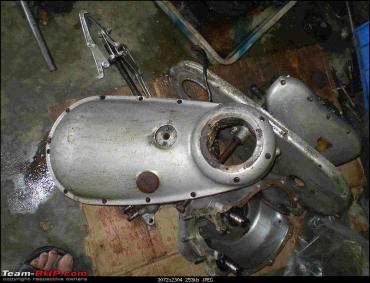
Primary and clutch are shot… though the aluminium cases look solid and serviceable. I bet it was a fun peek under the cylinder head and peering down the piston barrels into the heart of the twin. So remember kids if you ever want to abandon an old motorcycle distribute oil to the innards and cover the heck out of it with a protective layer of oil and put it away in a dark dry place away from prying eyes. Makes the discovery worthwhile…

The gas tank has seen better days and is past it’s useable life; probably only suitable as a wall ornament (in the garage or workshop of course). A nice included parcel rack could be cleaned, chromed and reused though.

After all of that discovery I think a cup of tea would be well deserved. The road ahead needs a bit of a head scratch before venturing onward…


November 4, 2012

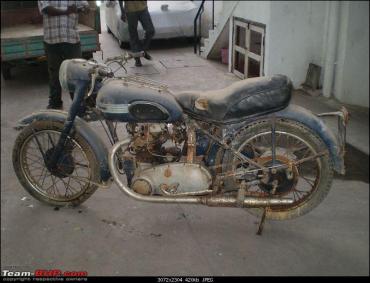
A Barn-find from the Sub-Continent

A Rat bike reborn…

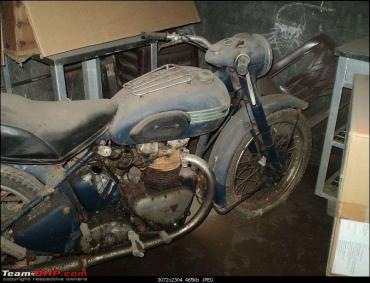
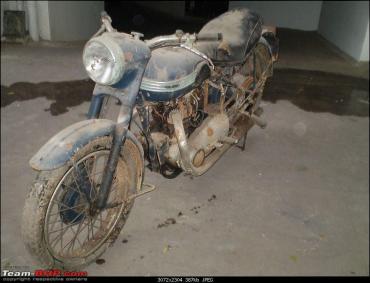
All over the world Triumph’s are still being unearthed from dusty sheds, oily tarpaulins, or aged cellars. Here is one such project from an Indian moto-forum where the owner, one Sanjay, based in Chennai, was gifted from a dear uncle. The photos show what 30-plus years in a basement off the monsoon airs of the Bay of Bengal can do. A complete looking bike but a LOT of work lies ahead. These were taken in 2009.

It’s got some rust issues. and may have some engine internals requiring a little more than basic machine work. However there is a worldwide network and supply chain of information available to these old gals’ restoration.

Ooh! To get my hands on something like this… It’s the Meccano builder in me; the lad who likes to take things apart; the biker who want to ride his very own machine… knowing every nut and bolt!


There’s a Speed Twin under there somewhere… a good soaking in oil, warm up the old Whitworth spanners and plenty of elbow grease… notebook, ziplock baggies, camera, and some helpful co-conspirators on the interweb or a local moto-group and the next several months or years are busied up!

…to be continued!

August 20, 2011

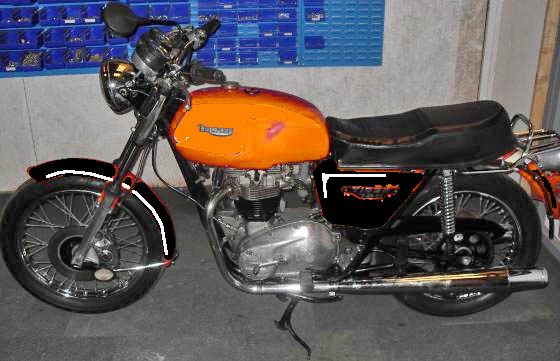
Le moto orange – c’est le fruit citrus

Another photoshopped image of a big tanked 70’s trumpet this time with black fenders/mudguards. Still considering this for my ride. The color of Eddy Merckx cycles.

Here’s Eddy ‘The Cannibals’ ride he used in Mexico City in ’72 to gain the hour record.

March 28, 2011

The ’72 Bonnie Cafe Project so far…

The updates to the bike have been taking shape over the winter. The bars have been swapped out for a pair of M-bars, a shape developed to work specifically with the 70’s steering triple tree where clubmans won’t fit. These are from Norman Hyde in England; he specializes in upgrades for both Meriden and Hinckley Triumphs. Also from NH are a pair or rearsets, these change footing position with well manufactured cast aluminium plates and gear and brake levers. There was some fanagling with the fitting points as these were developed for the pre oil in frame unit models. There is still some tweaking with the fine adjustements and mounting to ensure the kick start lever swings cleanly, the gear change pivots correctly and rear brake rod arm levers well.
The tank was repainted to include a Gulf decal, adding to the Le Mans theme. Also a narrow nosed seat from a T140V has been included, swapping out the boxier seat that came with the original project bike. New downpipes and long Dunstall mufflers complete the clean, low fast look I’m trying to achieve with this bike.

                         …looking forward to warm spring days!