


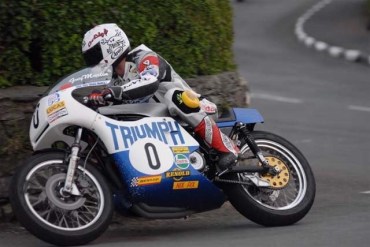
Road Racer – sharp corners and hard stone walls. It’s the TT circuit on Man’s Island in the Irish Sea. This is none other than the Kirmo Kid Guy Martin taking a Triumph Trident through its paces under leaden skies.
Road Racer – sharp corners and hard stone walls. It’s the TT circuit on Man’s Island in the Irish Sea. This is none other than the Kirmo Kid Guy Martin taking a Triumph Trident through its paces under leaden skies.

Rocket Three B&W – seem better days and in need of TLC; this 1970 BSA Triple is languishing at Ed Zender’s. A decent project for some unsuspecting soul willing to trade sanity for the chance to own a fairly rare motorcycle.
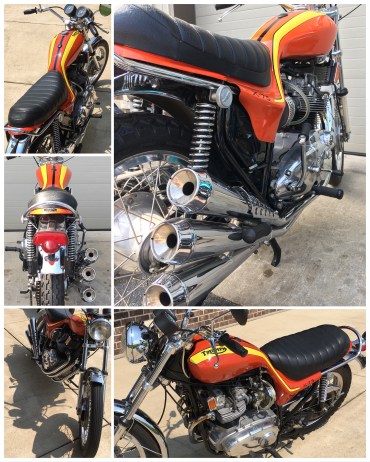
Hurricane – in an attempt to win over a flagging US customer Triumph and BSA employed industrial designer Craig Vetter to create bodywork for the new and fast triple that would appeal to the American market. Though a BSA Rocket Three at heart, by the time the X75 was released it was emblazoned with a Triumph badge. The deep orange with yellow swoosh are inspired with an hourglass shape that provides a sexy line to this muscle of a motorbike. Triple stacked silencers on the timing size are keenly futuristic. This example was built by Ed Zender for a customer. He says it runs well with a powerful and tight power unit. In the sun it’s a sublime example of a special British motorcycle.

A Full Head of Steam – Fill the boiler, stoke the fires, crank the flywheel, spin the governor. The Age of Steam Power fed the Industrial Revolution the explosion of society that would eventually become modern times. Some inventive folk like to adorn Victorian garb and assume an air of a contemporary age still driven under James Watt’s engines. Steampunk! Here’s a custom Triumph Triple set up as as if it were a 19th Century era Motorcycle.

The Mother Road – beautiful crisp graphic art by Antonio Ortega showing a MotoGirl sitting recumbent on her speeding triple. A lucky cat sits contentedly at pillion. All is Good in the World.
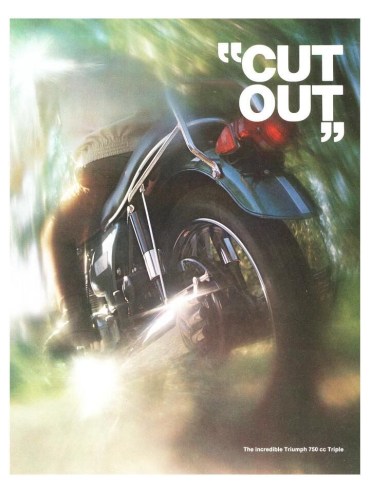
Rayguns – the signature exhaust mufflers of Triumph’s T150 sounded a heraldic trumpet to other bikers as the Trident hared past them.
Very seventies photography with blurring focus and a hint of movement during exposure.

Specifications
Make Model
Triumph Trident T150 750
Year
1968 – 70
Engine
Tansverse three cylinder, pushrod OHV, 2 valves per cylinder
Capacity
741 cc / 45.2 cu in
Bore x Stroke
67 x 70.5 mm
Compression Ratio
9.0:1
Cooling
Air cooled
Lubrication
Dry sump
Induction
3 x 26 mm Amal MK1 carburetors
Ignition
Individual points & coils
Starting
Kick
Max Power
58 hp @ 7250 rpm
Transmission
4 Speed, constant mesh
Final Drive
Chain
Gear Ratios
1st 13.00 / 2nd 9.00 / 3rd 6.64 / 4th 5.26:1
Frame
Single downtube, duplex cradle
Front
Telescopic fork, hydraulic
Rear
Swingarm, dual shocks
F Brakes
8 in TLS drum
R Brakes
7 in TLS drum
Front Tyre
3.25-19, Dunlop K70
Rear Tyre
4.10-19, Dunlop K70
Dimensions
Length: 86.0 in
Width: 33.0 in
Height: 43.5 in
Wheelbase
56.3 in
Ground Clearance
6.5 in
Seat Height
32 in
Dry Weight
460 lbs
Fuel
5.0 US gal / 4.2 Imp gal
Top Speed
105 mph

Dr Jekyll – the beast within. Specialist motorcycle performance component guru Norman Hyde has a solid history in making Triumph run quicker and faster. Under the tutelage of Doug Hele at the Triumph Racing Development Department he cut his teeth on making Bonneville’s and Tridents go like the clappers. Records were made on the drag strips with his meticulously engineered machines. Norman looks rather dapper in his weskit & jaiket astride a newer Bonneville for which he’s developed many performance parts.
My Bonneville has Norman Hyde rearsets and clubman handlebars… well, I think it goes quicker…

Face Left – Face Right
Looking like a proper motorcycle, this Triumph T150 Trident has all you need to enjoy the roads on two-wheels. Speed with Style. What more can one want?
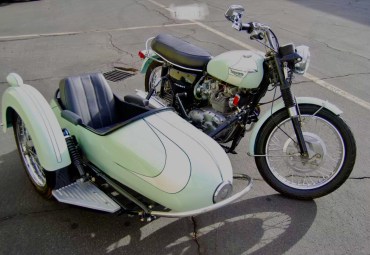
Jade Chair – seafoam pearl combination mounted to a suitable Trident ready for the driver and passenger. Operating an outfit is on my to-do list…
 Yellow Peril – Privateer racer John Parker built this Trident in the late seventies successfully competing in over 100 races.
Fettling includes: a Norman Hyde big bore kit; a Rob North frame; a stroked crankshaft; works cams; works steel-billet con-rods; lightened timing gears; triple Amal 30mm carburettors; works specification valves; Lucas RITA electronic ignition; a Quaife 5-speed close-ratio gear box; Ceriani forks; Essex wheel hubs; Borrani alloy wheel rims; Twin Lockheed front brake calipers; and a 3-into-1 exhaust system.
Fast? You betcha!

Skeletal Remains – like some machine archaeology the bare bones of a Trident frame and accessory components hint at a fully assembled and running motorcycle. Fossil remnants of a T-Rex giant lizard displayed through the interior spaces of a museum are only a cursory attempt at the frightening might they must have been. Likewise this assemblage of rolling chassis need fleshed-out to achieve brutal speed along a roadway.
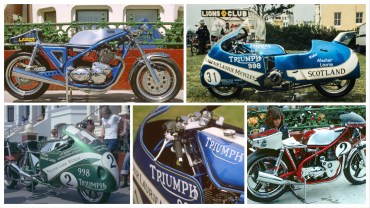
Homage to Loewy- further examples of Alastair Laurie’s ballistic bikes. Sleek machines which practically need a pilots license for sub-orbital flight.

Special Three – polished to a high speed. Isle of Man custom racer with blown engine from 1981 built by scot Alistair Laurie. Hailing from Dalbeattie, Dumfries in The Borders he took great pains to ensure integrity with lightness and style.

 geordiebiker.com