April 13, 2013

‘Gin

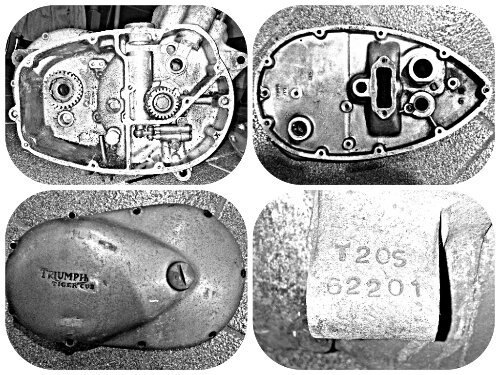
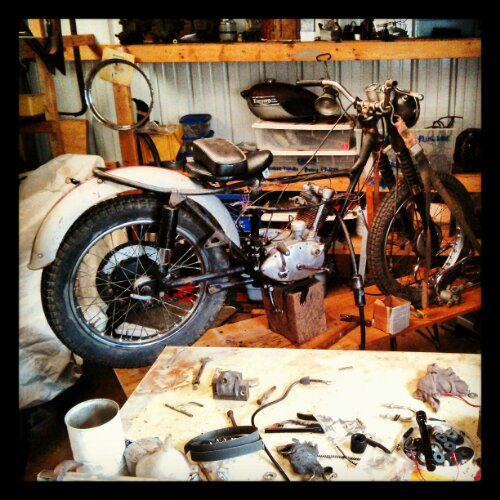
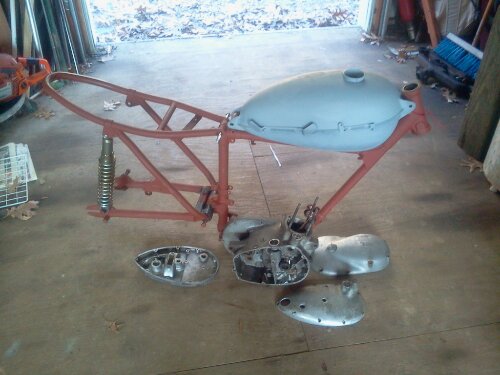
Two by Two: the engine cases need to contain the workings of the motor. Holding the moving pats that transfer the cyclical power through clutch and gear to the back wheel and thereafter road below.

image

Serial number denotes a 1960 model. Frame and cases match.

April 12, 2013

The Art of Balance

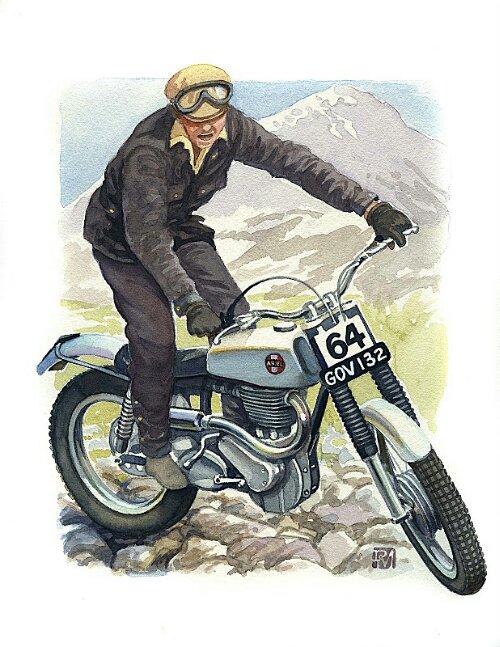
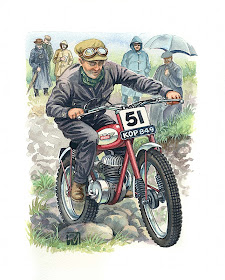
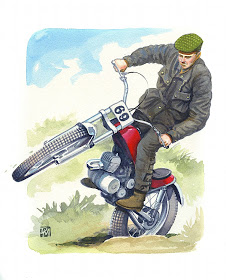
A few choice illustrations by a fine Canadian artist include these action trials paintings. Very evocative of a Highland scene with appropriately clad riders in tweed, flat cap or boiler suit.

image

An Ariel Hunter set up for slow speed over rugged terrain. Sammy Miller special.

image

James: two stroke beaut! Lightweight and geared to hop like a rabbit; in the bright hands of course.

image

Suzuki mid wheelie: another two stroker being revelled over damp grass. The Barbour jacket uniform of the ISDT rider. Must be Scotland!

Don MacMillan

April 11, 2013

Vacate

I’m watching the classic M. Hulot’s Holiday with the wonderfully visual Jaques Tati as the oblivious pipe smoking titular character. His small spluttering car makes several noisome appearances as he gets into numerous escapades at the coastal resort.

Jaques-Tati-voiture


Being less than a decade since the end of World War II is shows a french trying to relax and vacate themselves from life; however M. Hulot quietly and unknowingly intrudes on their R&R. If Chaplin was Blues, Keaton Folk then Tati is a Jazz Master.

Les_Vacances_de_M_Hulot

April 10, 2013

All Geared Up

How the Transmission Works.

Taken from a very clear explanation of the workings of the Cubs gearbox from  Princeton site which further details student group restoration of the 200cc gem. Larn yersel motorcycle mechanics! It’s basically three shafts, two of which spin on the same center, and a series of fixed or sliding gears that interlock to achieve different drive ratios transmitting power from the engine (via the clutch) to the back wheel. Great stuff!

A detailed look into the Triumph TigerCub 4-Gear Transmission System.
image

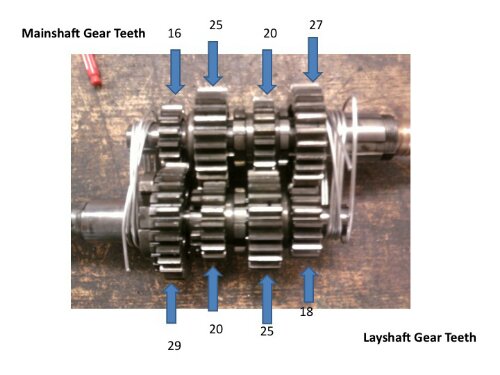
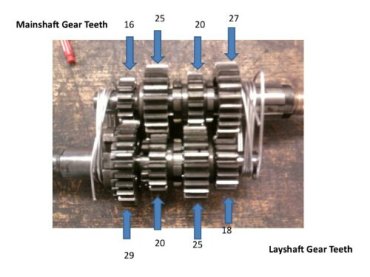
The transmission consists of two interlocking shafts with four gears each — the number of teeth on each gear is shown above.

image

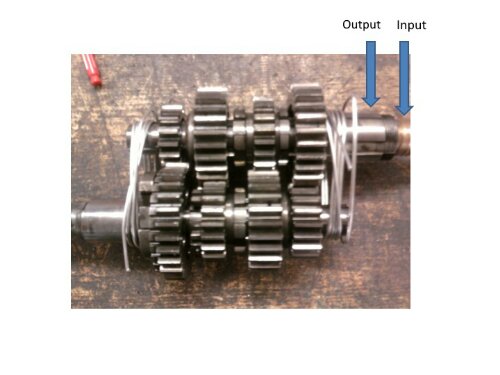
The two shafts are called the mainshaft (shown on the top) and the layshaft (on the bottom). In the TigerCub’s transmission, the mainshaft consists of two parts: the input shaft, which brings power from the engine, and the output shaft, which rides on a bearing concentric to the input shaft but outside of it, and which transmits power to the rear wheel. In the picture above, the input shaft is the smaller, copper-colored cylinder in the upper-right corner, and the output shaft is the larger, silver-colored cylinder to its immediate left.

image

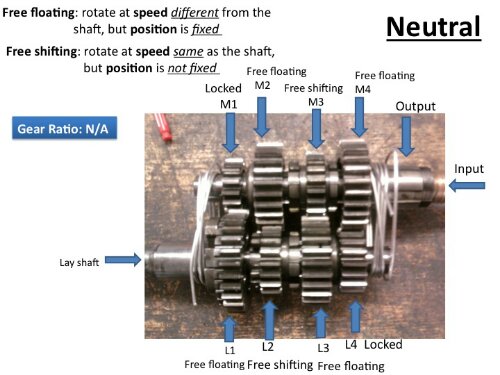
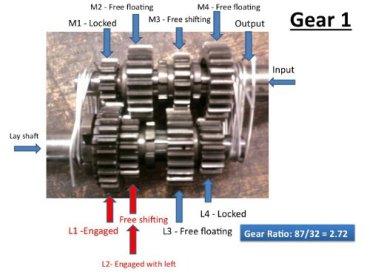
The input shaft is tied to the first and third gears on the mainshaft (M1 & M3)–that is, it co-rotates with them at the same angular velocity. M2 spins freely unless anchored to the mainshaft by M3, and M4 co-rotates with the output shaft. L2 and L4 co-rotate with the layshaft, and L1 and L3 spin freely unless anchored to the layshaft by L2.

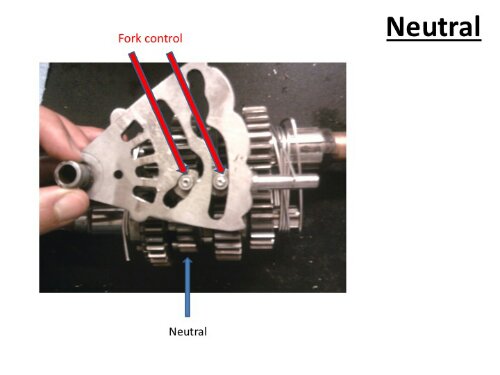
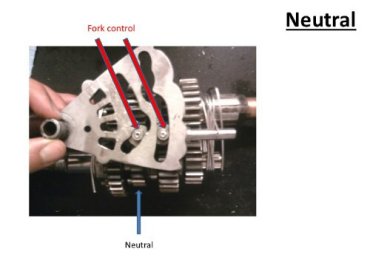
This picture shows the transmission in neutral–that is, the input is disengaged from the output, so the wheel receives no torque despite the engine’s running. M1 and M3 spin with the input shaft, but since M3 is not engaged with either M2 or M4, neither of those two rotates with the mainshaft. M1 and M3 drive L1 and L3, but since L2 is engaged with neither of those gears, they spin freely and the layshaft does not itself rotate. Thus the output via M4 is unaffected by the input.
image

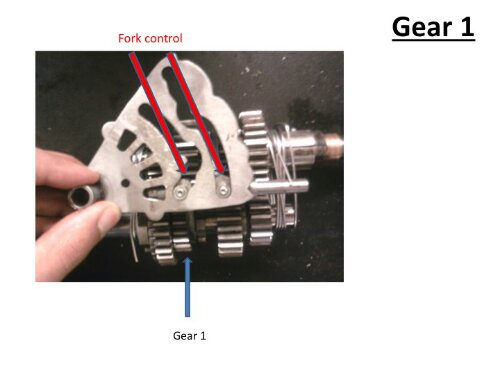
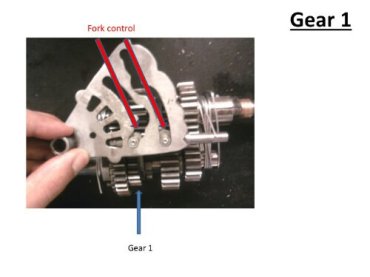
In shifting from neutral to first gear, L2 is moved to the left and engages with L1. This allows M1, co-rotating with the input, to drive the layshaft via L1. The spinning layshaft then drive M4 via L4, giving the gear ratio shown above.

Input => M1 => L1 => Layshaft => L4 => M4 => Output

image

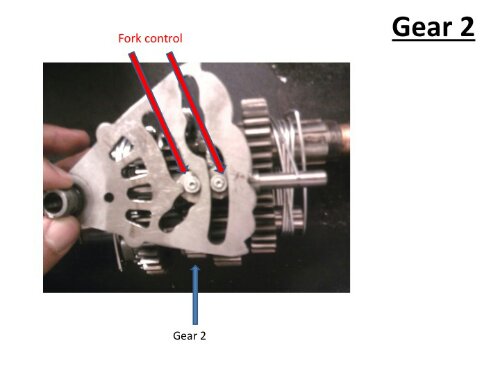
From first gear, L2 shifts to the right and engages with L3, driven by M3 in the middle position. L3 is smaller than L1, and M3 larger than M1, so a smaller gear ratio results.

Input => M3 => L3 => Layshaft => L4 => M4 => Output
image

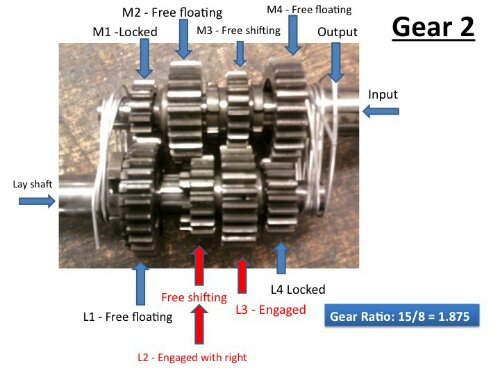
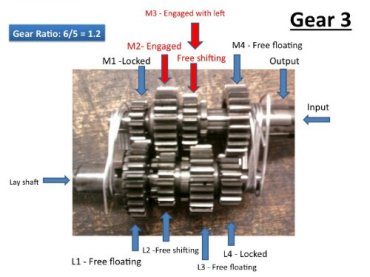
In third gear, L2 shifts back to its middle position, unengaged with either L1 or L3, while M3 shifts to the left and engages with M2. M2, co-rotating with the input, drives L2.

Input => M2 => L2 => Layshaft => L4 => M4 => Output
image

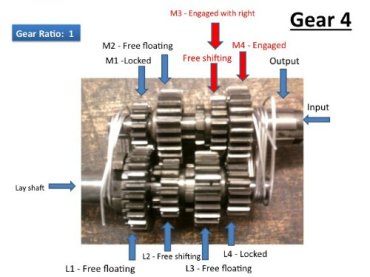
In fourth gear, L2 remains in the middle, and M3 shifts to the right to engage directly with M4, tying the input immediately to the output. As in neutral, the layshaft is not utilized.

Input => M3 => M4 => Output

image

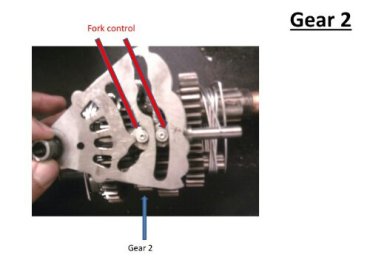
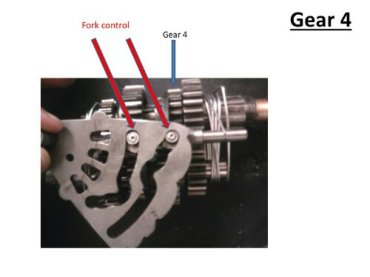
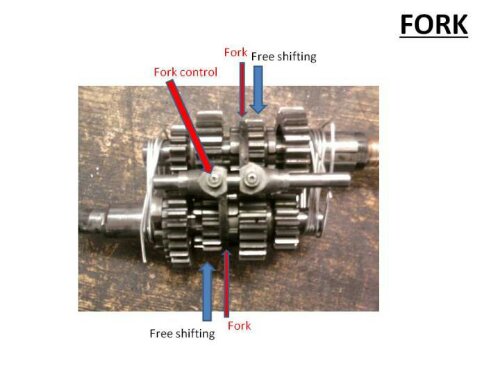
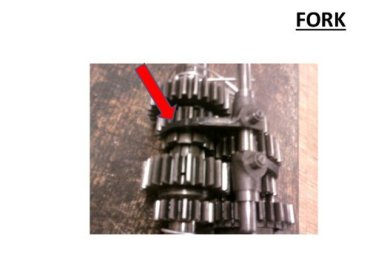
( Based on the position of the two shifting gears (M3 on the mainshaft and L2 on the layshaft), the gear ratio of the transmission is different.  The forks control the position of the two shifting gears by sliding them left and right along the shaft.  The forks are crescent shaped and fit into slots on the side of the shifting gears so that they are able to move the gears left and right but do not effect the rotation.
image

Side view of fork engaging gear shoulder.
image

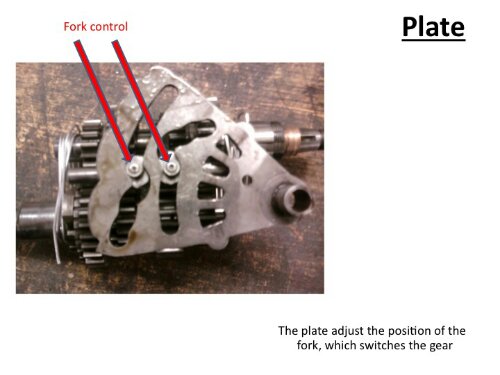
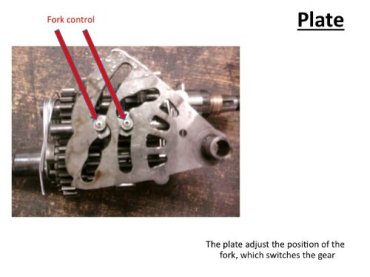
On top of each of the forks is a roller that fits into a pathway on the shifting plate. As the shifting plate changes positions, the fort-rollers follow the path, thus changing the position of the two forks. It is this motion that allows the transmission to change gears based on the position of the shifting gears.
image

image

image

image

image

April 9, 2013

One mans workshop

At the weekend when picking up the cub I had a spoach around the sellers workshop. He had a nicely organized garage set up with areas for working on different projects: another Tiger Cub, a Bultaco. There was even a flat track 650 hiding under a tarp. Shelves were lined with boxed and sorted spares, the rafters were draped in exhaust pipes and a daylit window offered good light.

image

Back in town another ‘collectors’ trove was introduced to us. This time the hoarding was more in evidence. Numerous British bikes, mostly BSA’s but a couple of Ariel’s in the corner, were lined up in grand sequence: a 40’s military M20, an A10, A65, B40. On his worktop stood a mostly complete 350 Beeza; free’d cylinders, new fluids, and it’ll be a runner in original patina. Smashing!

image

April 8, 2013

The Watchmaker

image

The wee Tiger Cub engine sure is cute: indeed after getting around the burly 650 Bonnie lump this is a thing of delicate precision. A pocket watch rather than a grandfather clock. I’m looking forward to exploring the guts of its inner workings: the single piston and supporting parts; an incorporated gearbox with four geared meshing and the tac-tic of the rocker arms as they open and close both inlet and exhaust valves. Var nigh simple engineering perfection.

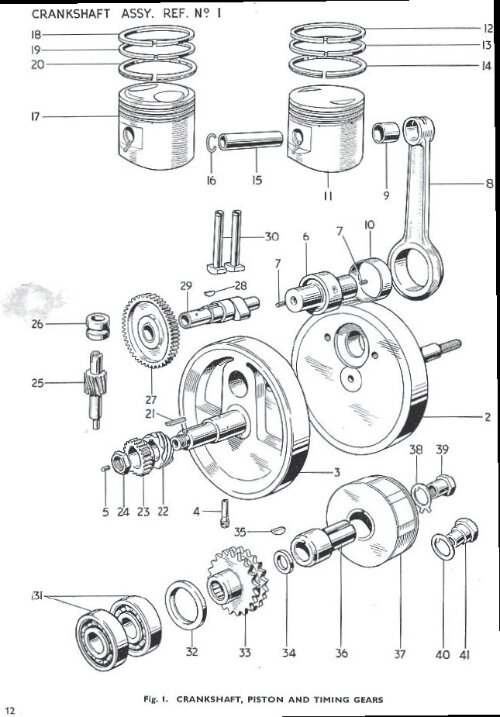
Of course the finely drafted exploded views from the essential parts manual help one find a way around the mechanics. Like a Greys Anatomy for the bike in question.

image

I hope I can scrounge up the parts to get this little ticker working again!

April 7, 2013

Cub Advert

As part of the work involved in a restoration you get to enjoy delving into the history of the bike; part of which is examining original advertising illustrations. Here’s a smashing item from some brochure extolling the virtues of these fifth liter machines. A Tiger Cub and Sport Cub: both T20.

image

Of course having the words of a real world champion quoted on the ad doesn’t do any harm either. Here Belgian Roger Vanderbrecken give a positive review of the Cubs.

April 6, 2013

Cub is a baby bear

image

Back from a long days drive over to the NW extremity of Illinois. The charming town of Galena nestled amidst the surrounding rolling landscape of that area. Quite bucolic. The seller Bill was a retiree with bikes and cars as a hobby. He was working on a couple of Cub projects and the frame and engine cases were surplus to requirements. The above picture is posted for inspiration! Also learned of a few Cubby specialists in the vicinity which may prove useful. As Sherlock might say: “the project is afoot!”

April 5, 2013

Next Project…

Dear oh dear oh dear! What do I get myself into? A nice northern Illinois jaunt over to Galena tomorrow to and look at, and most likely buy, this forlorn Triumph Cub frame in need of a home. Or some motorcycle restoring sucker! Well my thoughts would be to build a wee classic trials bike. Let’s see where this green lane leads us!
image

April 4, 2013

Trial Version?

Watch this Space: a new project is afoot.

triumph-trials-graphic


April 3, 2013

Moving Global Health Forward

Riders for Health is an international social enterprise. They manage and maintain vehicles for health-focused partners in sub-Saharan Africa. An expertise in transport management enables health workers to deliver vital health care to rural communities on a reliable and cost-effective basis. http://www.riders.org

image

Riders for Health manages over 1,400 motorcycles, ambulances and other four-wheel vehicles used in the delivery of health care in seven countries across Africa. 

image

Their Vision: world in which health care reaches everyone, everywhere.

image

Their Mission: to make the ‘last mile’ the most important mile in health care delivery: creating, showing and sharing the solutions for achieving truly equitable health care.

image

Mobilizing Health Workers: There are not enough health workers to provide vital services to communities across rural Africa. However, with Riders for Health’s managed transport systems, outreach health workers can increase their productivity and coverage.
The majority of health professionals mobilized by Riders in Africa are outreach health workers, who are responsible for traveling to rural communities and providing  services such as health education, disease surveillance, immunizations, maternal and child health services and HIV counselling.
Often the most effective form of transport for these health workers is the motorcycle which is cheaper to run than a four-wheeled vehicle and can cover more challenging terrain.
Riders has 20 years’ experience managing and maintaining motorcycles used by outreach health workers and understands the challenges they face. We understand how critical their role is and how important it is that they can reach their communities regularly and predictably.
An estimated 2.9 million extra people each year have interactions with health workers due to the health worker having a Riders-managed motorcycle.

Excerpts from RFH website. This is truly a worthwhile cause that has been carefully thought out in effective execution allowing many to be reached by a few. And that could make a difference for some.

April 2, 2013

Tee Short (as a Geordie would say)

T-Shirt sketch. Nice fluid scribble of a Beeza twin pre-unit engine. The three lobed timing side cover is very distinctive. Hand written notes list the essential engine components: piston, sparkplugs, carbs, exhaust etc. This top is one of Red Torpedo’s offerings, they make garb for motorcyclists; also used by the likes of road racers & mechanics like Guy Martin.

image

April 1, 2013

Cat on a Triumph…

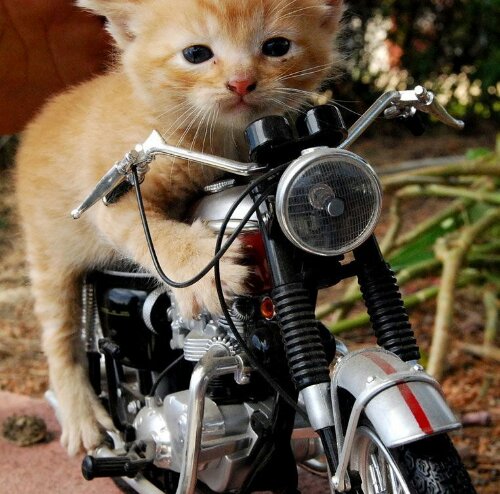
First  day of the fourth: a kool cat tries to look the part on a Bonnie. Tiger? Well a Cub anyways!

image

Kitty Racer.

March 31, 2013

Back on the Road

image

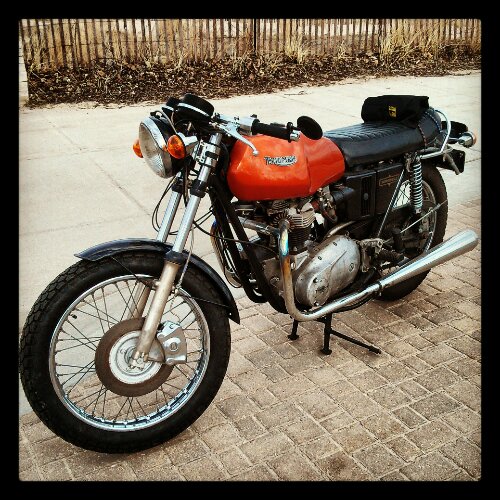
A winter project complete! Well it’ll never be complete, ever! But that is the ‘enjoyment’ of owning an old Brit Iron Moto. Took ‘er out for a shake-down and found the new stopper working very well; no fade; a nice feel with my typical couple of fingers feather braking. Still a little electrical gremlin to chase out of the chassis; they like to hibernate in Triumphs stored in dark dry garages! Nevertheless, the bike kicked over easily after sitting up for the winter. Should now get an early start this coming riding season.

March 30, 2013

New Front

A good couple of hours was spent this afternoon reattaching the front end to my bike. The ‘new’ triple tree was threaded back onto the frames head tube, making sure plenty of grease was slathered into the races. Then the fork stanchions slid back up the fork holders. Wheel mounted and a few more bolts tightened. That makes it sound easy but a few reassembly hurdles had to be surmounted.

image

Just the brake plumbing to finish, test drive double-check connections then the job’s a gud-un!